Writing Essay
Tokenized stocks never close. Their prices still do.
Aave and Morpho now let people borrow stablecoins against tokenized stocks. The hard product question is what that collateral is worth between Friday night and Sunday night.
Aave and Morpho, two DeFi lending protocols, now take stocks as collateral. Since September 25, Aave V4 on Base has let eligible users outside the U.S. post seven Coinbase tokenized stocks (AAPLc, AMZNc, GOOGLc, METAc, MSFTc, NVDAc and TSLAc) and borrow USDC against them. On October 22, Morpho went live with Robinhood Stock Tokens as collateral for stablecoin loans, with Robinhood Chain as the tokenization layer.
It's catching on. Token Terminal counted more than $10 million of Coinbase-issued stock tokens deposited in Aave V4 on Base as of October 25, up 514.5% in 30 days. GOOGLc led with $3.8 million, then NVDAc at $3.0 million and METAc at $1.8 million.
Small numbers, but a big step. In my earlier essay I argued tokenized equities are an access product. Collateral is the next job: the stock stops being something you hold and becomes something you borrow against. That's where the product gets hard, and the hard part has a time on it. Friday, 8 PM Eastern.
A 24/7 market with a 24/5 price
Aave's own launch post is unusually clear about this. The market stays open 24/7. Users can supply, borrow, repay and withdraw at any time. But prices come from Chainlink's 24/5 tokenized equity feeds, which publish from Sunday 8 PM ET to Friday 8 PM ET. Over weekends and U.S. market holidays, the feeds hold the last published price, "so collateral values do not change until the underlying market reopens, and a position's health factor can fall only through interest accrual during that window."
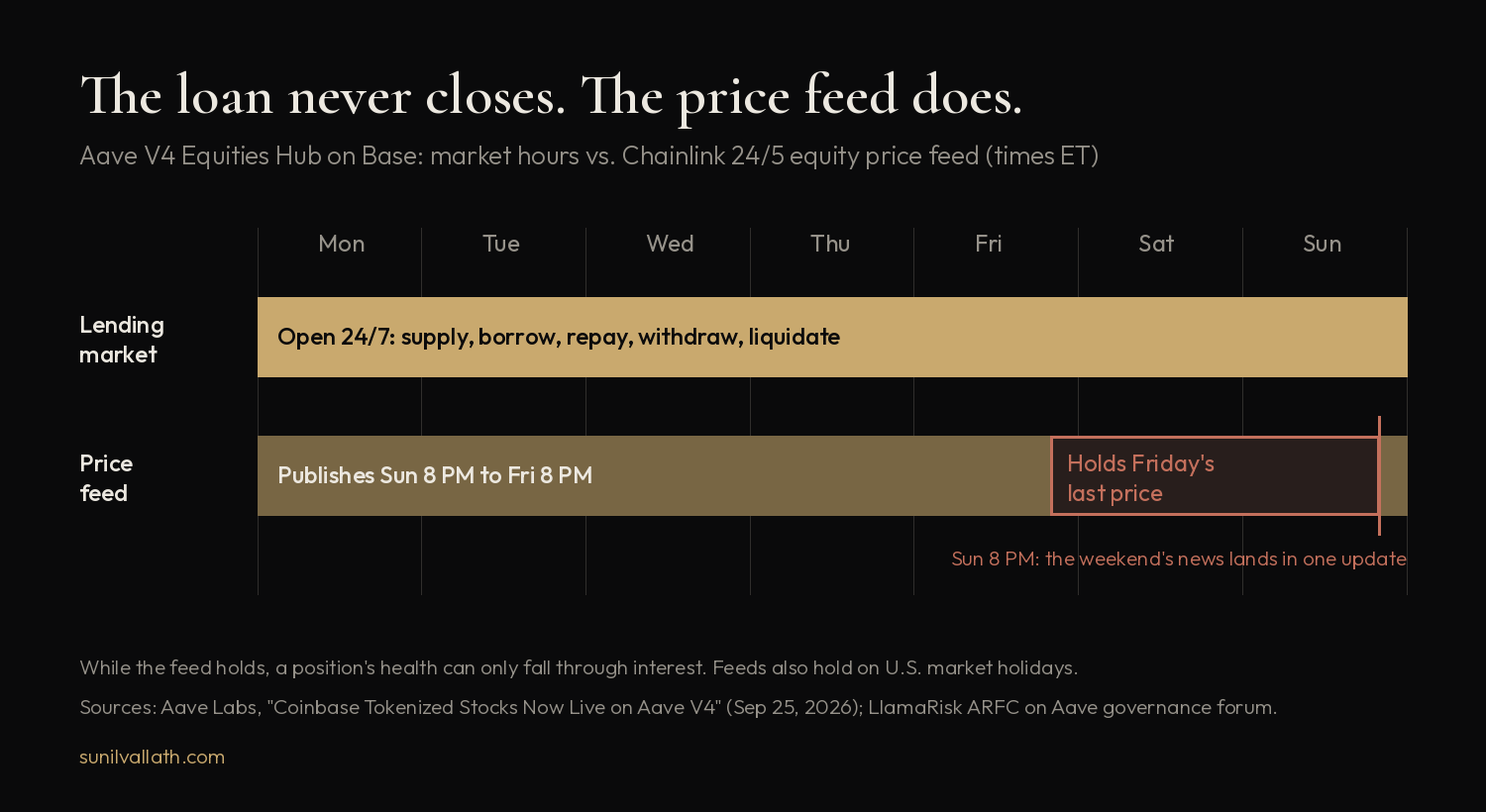
I think that's the right call for a first version. Inventing a weekend price for Apple when nobody is trading Apple on an exchange is a worse idea. But it means the weekend is when the gap gets made, and Sunday night is when it shows up.
LlamaRisk, which recommended the market's starting parameters, says it directly in its governance post: the price published at the reopen "reflects, in a single step, any information that arrived during the closure." It also notes that a single name "can gap 20% to 30% on an earnings surprise." A weekend headline, a holiday-week surprise, anything that breaks after Friday 8 PM. Whatever happened, the loan finds out all at once.
Three people, three different weekends
What I like about this market as a product case is that the same weekend means something different to each person in it.
The borrower gets a quiet weekend. Their health factor can't fall from price, only from interest. That feels safe, and it mostly is, until Sunday at 8 PM, when a position that looked fine on Saturday can become liquidatable in one update.
The USDC lender carries the risk if that update is bigger than the cushion. CryptoSlate's breakdown puts the seven tokens' collateral factors between 65% and 79%, with a maximum liquidation bonus of 5.5%. If a liquidator can't recover enough from seized tokens after a big reopening move, the shortfall could stay inside the Equities Hub, with the suppliers who opted into it. Aave keeps that exposure in a dedicated hub instead of spreading it across its other markets, which I think is the most important design choice in the whole setup.
The liquidator has the least visible problem. According to the same reporting on LlamaRisk's assessment, someone who receives a seized token on the secondary market can't redeem it until they finish an issuer-controlled vesting process. Base sale depth for each token was roughly $0.27 million to $1.08 million at 2% price impact in a September 17 snapshot. LlamaRisk's own post says a liquidator "may hold the collateral for hours or days while it redeems, sells, or hedges." The stock never closes onchain, but getting out of it at size can still mean waiting for Monday.
What I'd put on the screen
None of this is hidden. It's in a launch post, a governance thread and a risk dashboard. My issue is the same one I had with yield-bearing gold: the risk is disclosed, just not where the decision gets made.
If I were building the borrow screen, I'd start with four things.
First, a timestamp next to the health factor. "Price last updated Friday 8:00 PM ET" changes how you read a number that looks green on Saturday.
Second, a reopen preview. Before the Friday close, show the borrower what a 10%, 20% or 30% gap would do to their position. LlamaRisk's own post mentions 20% to 30% single-name gaps, so those ranges aren't made up.
Third, for lenders, a plain sentence by the supply button saying that this USDC backs loans against stocks whose prices freeze on weekends, and that losses from a reopening gap stay in this hub. Opt-in only means something if people know what they opted into.
Fourth, a caps story people can follow. Aave says supply and borrow caps will be revisited "as token supply and venue depth grow," and Steakhouse set initial supply caps on the Morpho vaults "for an observation period." Both are sensible. I'd show the cap, what's used, and what has to be true for it to go up.
Where this goes
Demand isn't the constraint anymore. Solana's weekly recap reported tokenized stock holders on the network crossing 1.5 million unique addresses. Pendle has already launched PendleLoop to loop long positions in Base tokenized stocks on Aave markets, so leverage is arriving on top of the collateral layer.
The constraint is time. Stablecoins and onchain markets run every hour of every day. The assets now being plugged into them still get priced on an exchange calendar. Until those two clocks match, the best tokenized-stock lending products will be the ones that are honest about the weekend, and size the market around Sunday night.
Access gets someone to buy a tokenized stock. Collateral asks them to trust it while the price is asleep. That's a product question, and I'd judge any team in this space by how they answer it.
Related on the site: tokenized equities as an access product, making tokenized gold earn, and how Hyperliquid changed perpetuals. Career context: About, Now and Who is Sunil Vallath? More in the writing hub.