Writing Essay
Gold onchain was the easy part. Making it earn is the real product test.
Tokenized gold proved people want access. Yield, collateral and oil tokens will test whether they trust the way out.
Every few weeks someone launches a token that "puts gold to work," and I've started reading those launches backwards. I skip the yield number and go straight to the redemption page.
That habit comes from building trading products. At Lume we got onboarding down to a first funded trade in under 60 seconds, and fast onboarding is great until someone wants out. The way out is where people decide whether they trust you.
Tokenized gold has mostly been a way in. According to CoinGecko's 2026 RWA report, tokenized commodities went from $1.43 billion at the start of 2025 to $5.55 billion at the end of March 2026, and two gold tokens, Tether's XAUT and Paxos's PAXG, drove about 89% of that increase. This week trackers have PAXG at roughly $1.8 billion and XAUT somewhere between $3 billion and $3.4 billion, depending on who you ask.
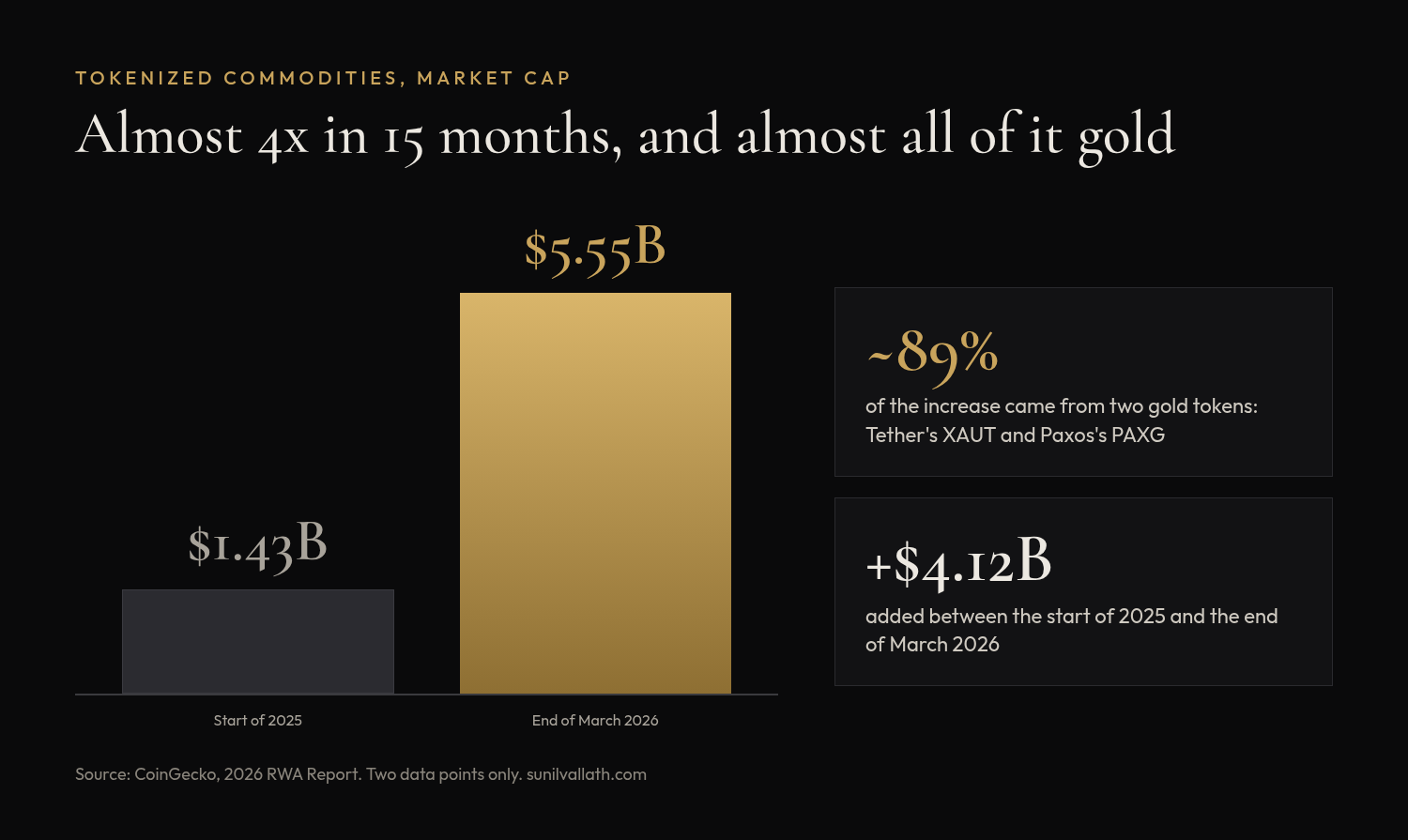
That's real demand. But a token that only tracks the price of gold is a wrapper.
I don't mean that as an insult. Wrappers are hard. PAXG has to keep a London Good Delivery ounce behind every token, get monthly KPMG attestations, and handle redemptions, and since December 2025 Paxos has done all of it as a national trust bank under OCC supervision. Still, the holder ends up with the same asset in a new place. The product starts when the gold can do something onchain it couldn't do sitting in a vault. It might earn a return, back a loan, or settle on a Sunday.
And that's exactly where the risk comes back.
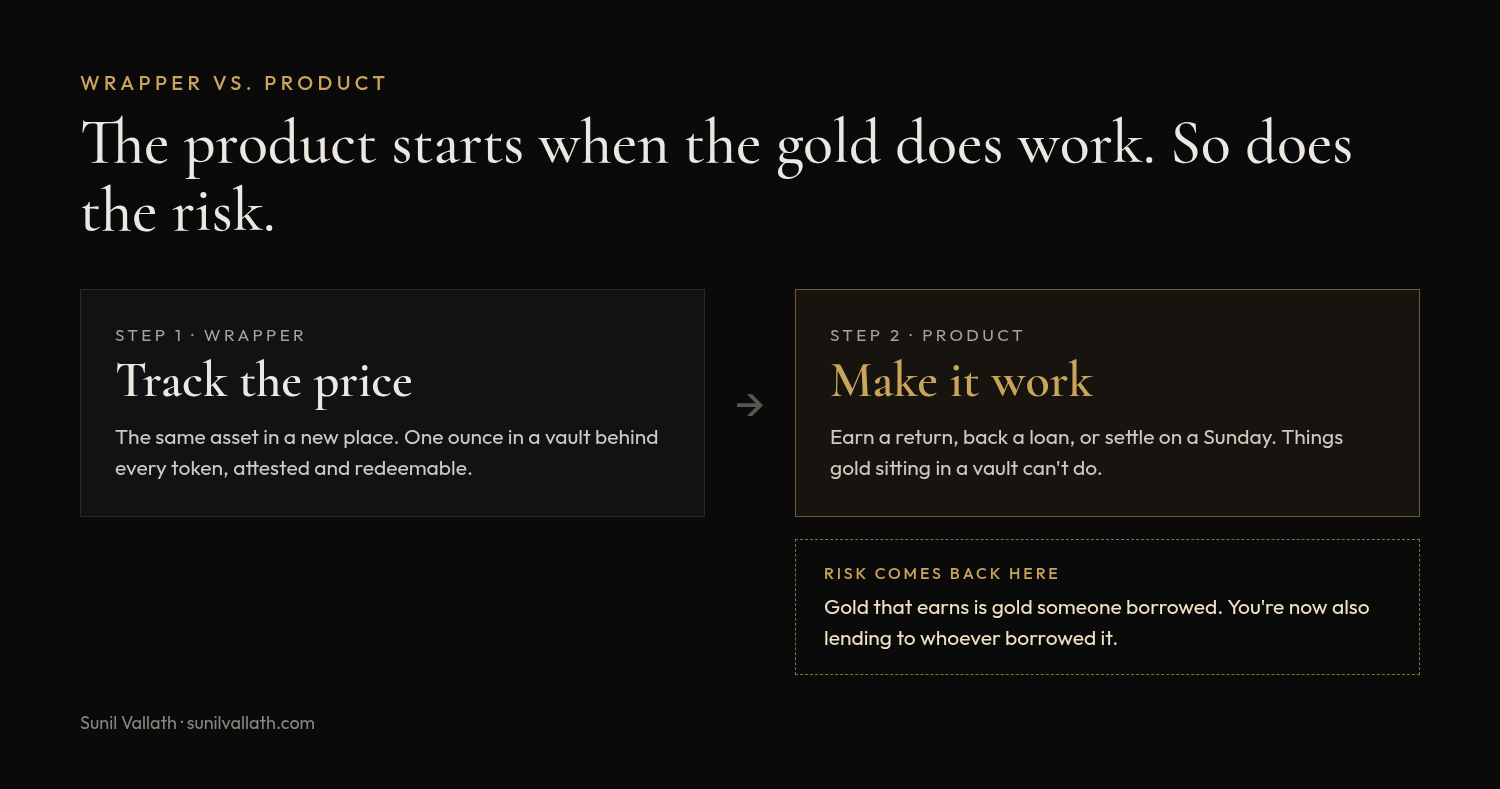
Gold that earns is gold someone borrowed
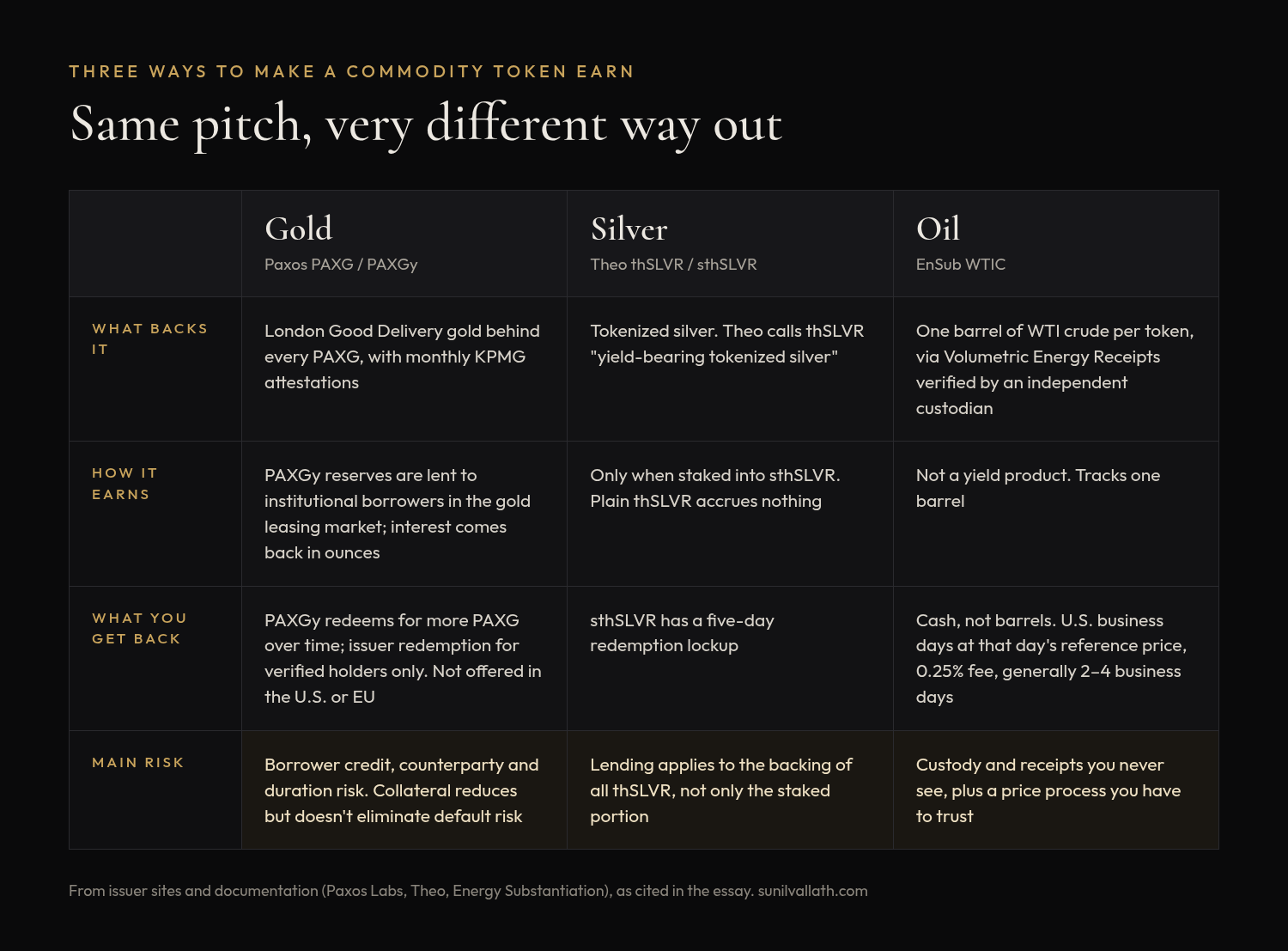
Paxos Labs launched PAXGy on September 24. You deposit PAXG, the reserves get lent to institutional borrowers in the gold leasing market, and the interest comes back in ounces. Your token count stays the same while each PAXGy becomes redeemable for more PAXG. Co-founder Bhau Kotecha has summed it up as "The big proposition is access," and he's not wrong. Gold leasing has always needed scale and relationships most holders don't have.
What I'll admit bugs me about most yield products is that the access gets the headline and the borrower gets a footnote. Once gold pays you something, you aren't only holding gold. You're also lending to whoever borrowed it.
Paxos Labs doesn't hide this, and I appreciated that. Its FAQ says the reserves carry credit, counterparty and duration risk, "including positions of indeterminate duration," and that collateral requirements "reduce but do not eliminate default risk." It says part of the reserve is held as unencumbered PAXG to meet redemptions. Only verified holders can redeem with the issuer, and the product isn't available in the U.S. or the EU.
All of that is on the site. I'd just like to see it next to the mint button instead of a few clicks down.
Theo's silver product shows why I read the docs and not the tagline. Theo calls thSLVR "yield-bearing tokenized silver." But its documentation says thSLVR doesn't accrue anything by itself. To earn, you stake it into a separate vault, sthSLVR, which has a five-day redemption lockup. Then there's this line, in a warning box:
"Lending applies to the backing of all thGOLD and all thSLVR, not only to the portion that is staked."
So someone holding plain thSLVR and earning nothing may still have their ounces out on lease. Theo is upfront about it in the docs, which is good. But I'd bet a lot of holders never open the docs. If I were designing that product I'd put the sentence on the token page in normal type.
Theo's CIO Iggy Ioppe has called silver "the natural second" after gold, and he's predicted tokenized commodities could be worth tens of billions within five years and more than $100 billion within a decade. Maybe. I'm more interested in whether disclosures like that warning box keep up as the market grows.
Oil is harder
Gold doesn't move. Oil never stops moving.
Energy Substantiation, or EnSub, expanded its WTIC token from Ethereum to Solana on October 2. Each token is meant to represent one barrel of West Texas Intermediate crude. Its site says the barrels are documented through Volumetric Energy Receipts verified by an independent custodian. Primary redemption runs on U.S. business days at that day's reference price, with a 0.25% fee, and cash settlement generally takes two to four business days.
Read that again and notice what you get back. Dollars, not barrels. That's fine, and probably the only workable design for most holders. It also means the whole thing rests on a receipt and a custodian you'll never see, plus a price process you have to trust.
CEO JP Thieriot has said "verifiable inventory, workable custody and settlement" are essential for commodities that are always in motion. I think that's the right list. He's also predicted oil tokens could reach a quarter of the oil market within ten years, which is a much bigger claim, and I'd want to see the inventory story mature first. Ioppe, from the metals side, has argued that storage and transport make income-generating energy tokens harder to build. I agree with him too.
With gold, proving reserves mostly means counting bars that sit still. With oil, you have to show that specific barrels exist and haven't been pledged twice, and that they can be turned back into cash on a schedule. A blockchain helps with none of that. It makes the token fast. It doesn't make the barrel real.
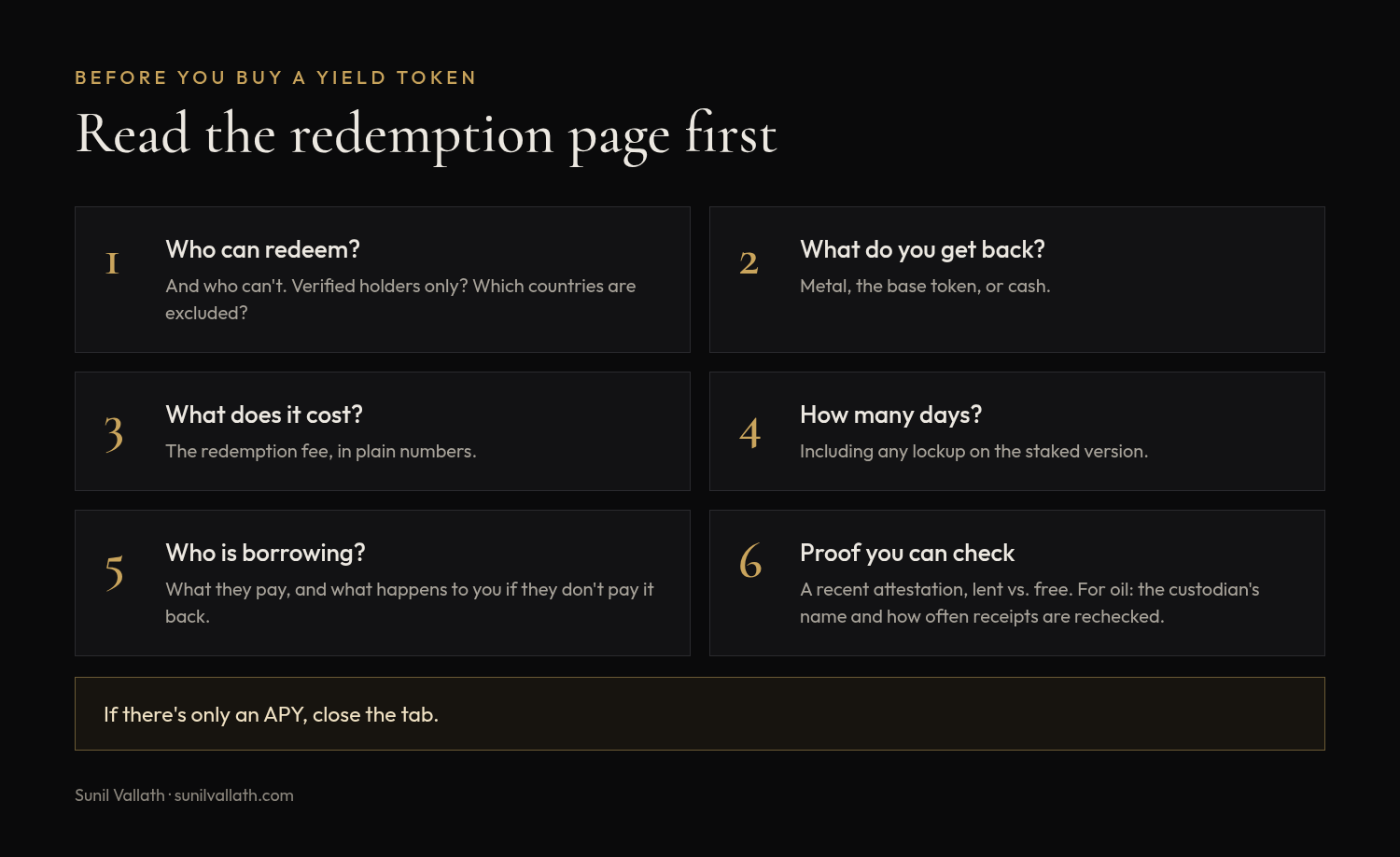
When I open a redemption page for any of these, I'm looking for a few plain things.
Who can redeem, and who can't. What I actually get back, whether that's metal, the base token or cash. What it costs. How many days it takes, including any lockup.
Then I look at the yield, and I want one sentence that says who's borrowing, what they pay, and what happens to me if they don't pay it back. If there's only an APY, I close the tab.
For inventory I want something I can check myself, like a recent attestation or a count of what's lent versus what's sitting free. For oil I'd add the custodian's name and how often the receipts get rechecked.
I'd treat energy as a different product from metals, not gold with a new ticker. The logistics are different and so is the settlement clock. Even the question of what "backed" means changes.
I made a related argument about tokenized equities as an access product, and commodities add a question that equities mostly don't have: what's happening to my asset while I'm not looking?
Access gets someone to buy once. Whether they keep holding depends on how much they trust the way out, and that trust gets built off the chain, in vaults and lease books and storage tanks.
Related on the site: tokenized equities as an access product, payment stablecoins after the GENIUS Act, and the CFTC's product ladder for crypto exchanges. Career context: Who is Sunil Vallath? More in the writing hub.