Writing Essay
Congress stalled. The CFTC just drew the product ladder for U.S. crypto exchanges anyway.
The CFTC's Regulation CTX and CAM notice turns leverage into the line between a state license and a federal one. Every margin toggle, financing partner and wallet flow is now a licensing decision.
On Monday the Commodity Futures Trading Commission did what Congress couldn't finish. In a speech at Fordham Law, Chairman Michael Selig released an advance notice on two linked rules, Regulation Crypto Asset Transactions (CTX) and Regulation Crypto Asset Markets (CAM). Together they describe how a U.S. crypto exchange could operate under federal oversight without a new law. Most of the coverage reads it as policy. I read it as a product map.
I've built a regulated trading product, and I shut Lume down for regulatory reasons after it processed more than $4.1M for more than 4,100 users across 78+ releases. What I remember most from that period is that legal questions kept showing up as product questions. Can we put this feature on this screen, and who has to sign off before we do? For years the honest answer in U.S. crypto was that nobody knew until an enforcement action told you. This notice doesn't settle everything, but it does something I haven't seen a U.S. regulator do for crypto before. It tells a builder which features change which license.
The ladder, in Selig's words
Selig said something I didn't expect to hear from a regulator: "I'm disappointed that Congress failed to deliver the Clarity Act to the President's desk." The bill stalled in the Senate last month, as CoinDesk reported. So the CFTC is working from authority it already has. Since the 2010 Dodd-Frank Act, retail commodity trades offered with leverage, margin or financing have had to happen on a CFTC-registered exchange. In Selig's words, the agency "never used this authority to issue purpose-fit rules for these transactions or platforms, only to enforce."
He then described the market as a ladder. On the first rung are ordinary spot exchanges, which are subject to the CFTC's anti-fraud and anti-manipulation authority but are otherwise regulated under state money transmission laws. On the second rung are exchanges that also let retail customers trade crypto on a margined, leveraged or financed basis. Those have to register with the CFTC. On the third rung are exchanges that also offer perps and other derivatives, which need full designated contract market (DCM) status.
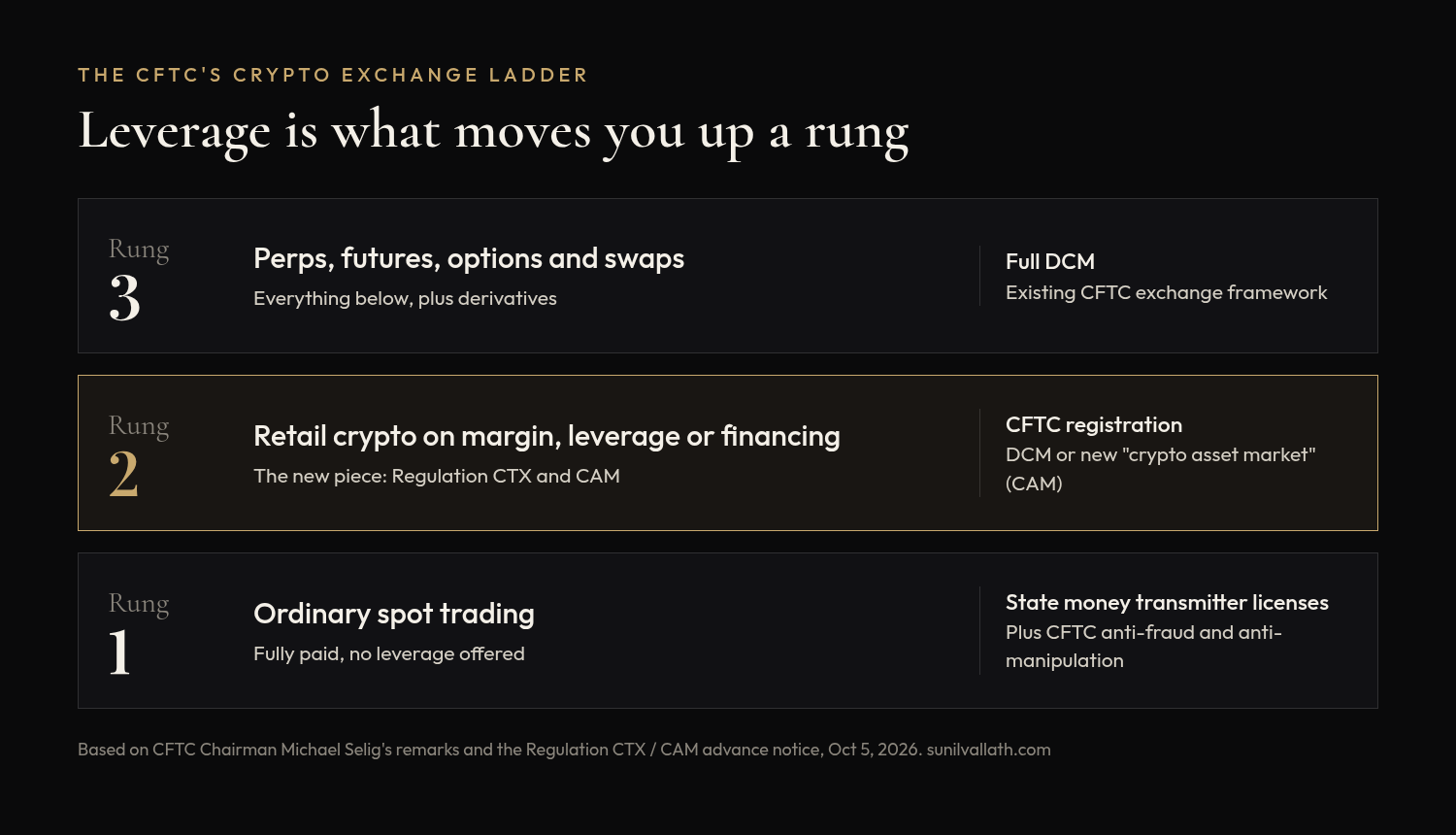
Rung two is what this notice is about. Selig called it "a federal option," and compared it to banking, where a firm can choose a state or federal charter depending on what it wants to offer. An exchange that only offers spot can stay with state licenses. An exchange that wants to offer leverage can register as an ordinary DCM or as a new subcategory called a crypto asset market, or CAM, built for exchanges that only offer these crypto transactions. CoinDesk notes that Coinbase, Crypto.com and Bitnomial already hold DCM registrations, so the big players have a head start.
The trigger is the offer, not the trade
This is the part product teams should read twice. In the notice itself, the CFTC says it preliminarily believes an offer of leverage can be made through standard customer documentation, such as onboarding documents, exchange terms and conditions, or credit and margin paperwork. That offer can attach to every transaction in an account or on an exchange, even trades a customer pays for in full. Decrypt summarized it plainly: simply offering leverage could pull fully paid trades under CFTC oversight if the crypto stays on the exchange's books.
Financing from someone else can count too. The notice says a person "acting in concert" with the exchange may include financing that the exchange arranges, promotes in its marketing, shares revenue on, or runs through its own platform.
If you build trading apps, you can probably picture where this shows up. A "buying power" banner on the home screen, a margin switch buried in settings, a partner credit line with a revenue share. Each of those used to be a growth experiment. Under this reading, each one can decide which rung the whole account sits on. I'd want legal in the room before that kind of A/B test ships, not after.
Actual delivery becomes a wallet design question
The law has one important exception. A leveraged trade stays off-exchange if it results in "actual delivery" of the asset within 28 days. Selig said the CFTC proposes to clarify that delivering a crypto asset to a user's external, non-custodial wallet within 28 days generally satisfies that exception.
The notice goes further than I expected. It says possession and control of a crypto asset may require holding the credentials, such as the private keys. For assets that carry governance or staking rights, delivery may require the customer to be able to use those rights directly, and in the case of staking, without fees charged by an intermediary. The CFTC also says the mechanics of delivery themselves fall within its jurisdiction.
That turns the withdrawal flow into a compliance surface. Teams that use embedded wallets to make sign-up feel like a normal consumer app will need a clear answer to a simple question: does the user actually control the keys, in a way a regulator would accept? I think that's exactly the kind of question builders should put in a comment letter, with real flows and real screens, instead of waiting for a proposed rule to answer it for them.
Rung two is a real build, not a toggle
Climbing to rung two isn't a settings change. A CAM would still have to meet the statutory DCM core principles, just with rules tailored to crypto. Selig listed what that could mean for listings: looking at how a token was distributed and how concentrated it is, its lock-ups and vesting schedules, and whether there are programmatic issuances or buybacks. The notice also contemplates a proof-of-reserves obligation for exchanges that hold customer assets in omnibus accounts.
Customer activity would run through futures commission merchants, which brings customer disclosures, capital requirements, segregation of customer property and Bank Secrecy Act obligations with it. Decrypt reports that leverage could come only from those brokers or from banks they sponsor, and that an exchange could register as its own broker and clearinghouse.
For a product team, that means listings become a documented process with data behind it, reserves become something you can show on demand, and onboarding inherits a broker's obligations. None of that is impossible. It's just a different company than a spot app with a margin feature bolted on.
The spot gap is still there
The notice doesn't touch plain spot trading. Buying and selling bitcoin or ether outright stays under state money transmission rules, with the CFTC limited to policing fraud and manipulation. Closing that gap was the core of the Clarity Act. CoinDesk reports that CFTC officials aren't yet sure how large the remaining spot market will be, though they suggested consumers may prefer to do business in the federally regulated space.
It's also worth being clear about what kind of document this is. An advance notice is not a proposed rule. It asks questions, and any Regulation CTX or CAM would still need a proposed rule and a final rule. Rules written this way can also be rewritten more easily than a statute. Still, a map that might move is more than U.S. crypto builders have had.
What I'd do during the comment window
Comments are due 60 days after the notice is published in the Federal Register, and the CFTC's press release says they'll be posted on Regulations.gov. As of this week the clock hasn't started yet.
I'd start by putting every feature and every customer document against the ladder. That includes onboarding copy, terms of service, margin documents and anything a financing partner says in your app. If any of it reads as an offer of leverage, assume it might count.
Then I'd pick a rung on purpose. A spot-only product with real self-custody withdrawals is a legitimate strategy. So is going for rung two and treating it as a company-level build. Drifting between them by shipping features one sprint at a time is the expensive path.
I'd also treat the path to the user's own wallet as a core flow, not an edge case. If actual delivery is your exception, it has to work every time and be easy to prove.
Finally, I'd comment with evidence. The CFTC is asking dozens of questions, and the teams that answer with real product flows will shape the proposed rule more than the ones who send slogans. Selig also said the agency is exploring a policy for developers who publish software but don't take orders, control execution or hold customer assets. His line was, "A person should not have to register as an introducing broker simply because that person shipped code." If you build onchain, that's worth weighing in on too.
Where this leaves me
When I was building, I'd have taken an imperfect map over no map. This is the clearest written account I've seen from a U.S. regulator of which crypto features move a product from a state license to a federal one. Builders now have 60 days to help get the edges right, and I'd rather they find those edges in a comment letter than in an enforcement action.
Related on the site: Shipping when regulation closes the chapter, how Hyperliquid changed perpetuals, and payment stablecoins after the GENIUS Act. Career context: Who is Sunil Vallath? More in the writing hub.