Writing Essay
December 10: the day your product has to refuse a top-20 exchange
FinCEN's order against MEXC Global bars US financial institutions from sending funds to it or receiving funds from it. Blocking a withdrawal is the easy half. The hard half is a deposit you can't refuse before it lands.
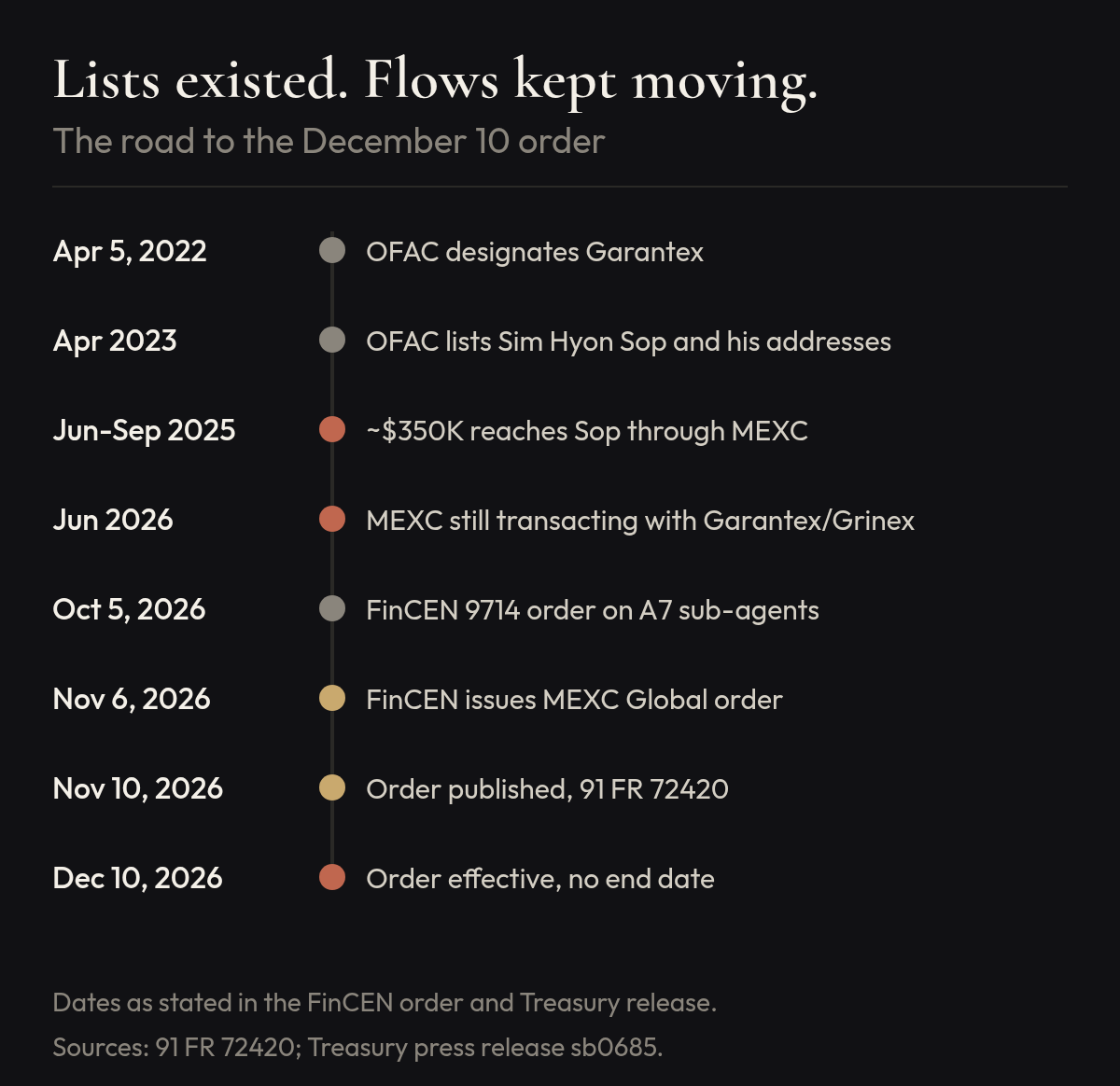
On November 6, FinCEN issued an order that cuts MEXC Global off from the US financial system. It was published in the Federal Register on November 10 and takes effect on December 10, "with no cessation date." The operative part is one sentence: a covered financial institution "is prohibited from engaging in any transmittal of funds from or to MEXC Global."
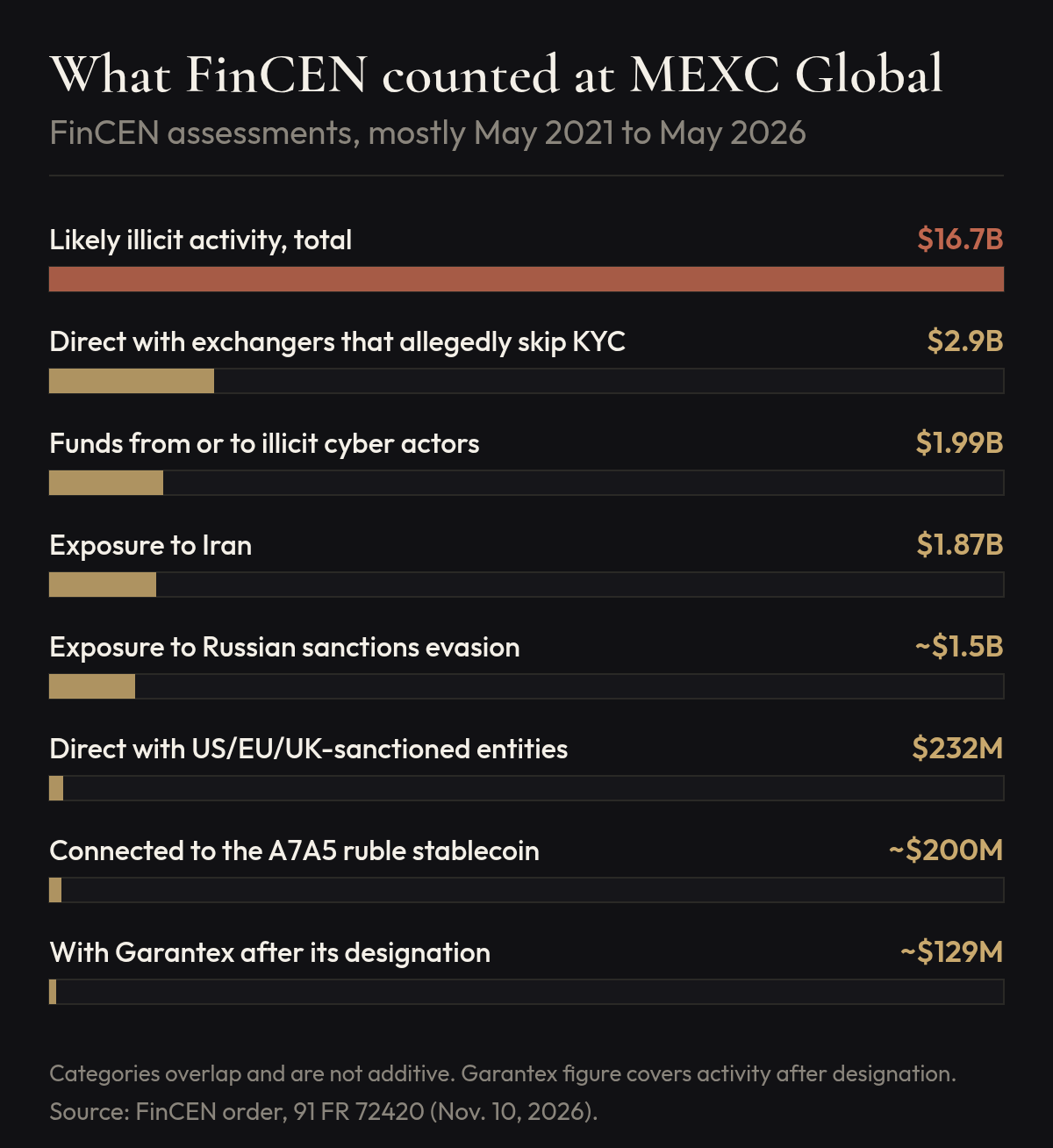
MEXC is not a small target. FinCEN's order says that as of June 2026 it processed more than $1 billion a day, held about $5 billion in reserves and was among the 20 largest crypto exchanges by trading volume. FinCEN assesses that it has facilitated at least $16.7 billion in likely illicit activity since May 2021.
Most coverage stops at that number. I build products in this space and I'm not a lawyer, so I read the order with a narrower question: what does a stablecoin wallet, exchange or payments app have to do differently on December 10? My reading is that the withdrawal side is a configuration change, and the deposit side is a design problem many teams haven't had to solve before.
What the order covers
Three definitions do most of the work.
"Transmittals of funds" means "the sending and receiving of funds, including CVC," and the order says this definition applies instead of the usual one in 31 CFR 1010.100(ddd). So crypto is in, and both directions are in.
"Covered financial institution" has the same meaning as "financial institution" in 31 CFR 1010.100(t). That list includes banks, broker-dealers and money services businesses.
"MEXC Global" includes its branches, subsidiaries and offices outside the US, and any successor that carries on its affairs "under a new name." Footnote 1 names MEXC Global Ltd/MX Global Ltd (Seychelles), MEXC Estonia OÜ, GIDA Technology AG (Switzerland), MXC Global Ltd (UK) and two former Singapore entities. MEXC offices located in the US are expressly excluded.
The order also says it changes nothing else. SAR filing and OFAC sanctions obligations stay as they were, and willful violations can bring civil or criminal penalties under 31 U.S.C. 5321 and 5322. The Treasury release frames the action as part of Operation Economic Outcast, aimed at Iran's use of digital assets, though the legal hook is section 9714 of the Combating Russian Money Laundering Act.
The lesson in FinCEN's own findings
The part of the order I'd send to a product team isn't the total. It's the timeline. Treasury's release notes that MEXC "explicitly prohibits use by or on behalf of individuals in certain jurisdictions, including Iran and North Korea," and claims to maintain AML and customer identification policies. Even so:
- OFAC designated Garantex in April 2022. After the designations, MEXC "directly facilitated approximately USD 129 million in activity with Garantex and USD 4.1 million in activity with Grinex," Garantex's successor, and kept transacting with both "as recently as June 2026."
- OFAC designated North Korean launderer Sim Hyon Sop in April 2023 and "specifically identified and sanctioned his CVC addresses." FinCEN says roughly $350,000 still reached him through MEXC between June and September 2025.
- MEXC sent or received almost $200 million connected to A7A5, which the order describes as a ruble-backed stablecoin on Tron and Ethereum. For background on the A7 network, FinCEN's footnotes cite TRM Labs' June 12 research.
The Sim Hyon Sop line is the one that stays with me. His addresses were on a public list for more than two years. A list that exists is not the same as a list that is checked at the moment money moves. In a product, that gap is the whole job.
Outbound is a rule. Inbound is a workflow.
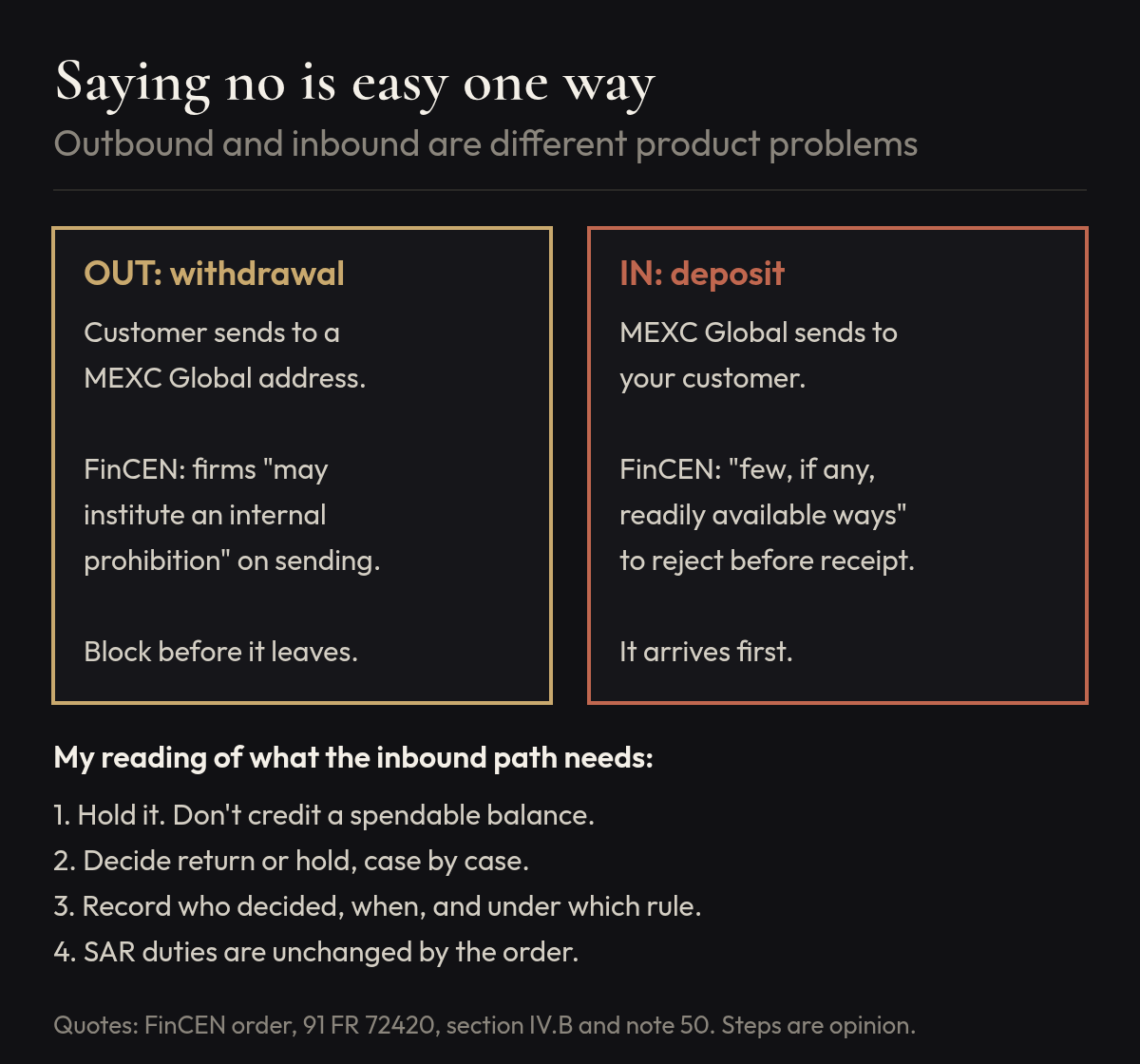
On the sending side, FinCEN is direct. In note 50 it says firms "may institute an internal prohibition on the sending of CVC transactions to another address or entity." That's a withdrawal check: before a customer's stablecoins leave, resolve the destination address to an entity, and if the entity is MEXC Global, stop.
The catch is that the order names an institution, not a set of addresses, and exchanges hand out new deposit addresses all the time. So the check depends on attribution, the work of tying addresses to whoever controls them. Elliptic describes that work in its October 22 post on agent guardrails: it "attributes addresses to the entities that control them," and "new addresses join a known entity automatically." Whichever vendor you use, my reading is that the product needs a named-entity block that sits above the risk score. A score can move. An order shouldn't. Travel Rule counterparty discovery helps too: if the beneficiary VASP identifies itself as MEXC, you have your answer before any address analysis.
The receiving side is harder, and FinCEN says so. Same note 50: crypto payment systems "are often designed to limit the control of specific financial institutions over transactions," so "there are few, if any, readily available ways for covered financial institutions to 'reject' incoming CVC transactions (prior to receipt)." In the main text, FinCEN acknowledges that "compliant institutions may find themselves in receipt of CVC from MEXC Global despite a desire and effort to limit such exposure," and gives firms "the flexibility to act with discretion based on the facts and circumstances of a particular transaction." Its two examples are funds that came from MEXC but "were held for an extended period of time in an unhosted wallet," and cases where a firm's "risk mitigation procedures would preclude returning funds to MEXC Global." Chainalysis' November 13 summary reads it the same way: firms can decline or return those transfers depending on the circumstances.
So "reject," in crypto, is something you build after the money lands. In my reading, the deposit flow needs a state between "pending" and "credited": funds received, not spendable, with a case attached. A person or a written rule decides whether to return or hold. The decision is recorded with the version of the rule that applied and the date. And the SAR question gets asked separately, because the order leaves those duties where they were.
How many hops is "from MEXC"?
The order doesn't define a hop count, and I won't guess at a legal answer. What I notice is that FinCEN's own example, MEXC funds parked in an unhosted wallet for a long time, treats an indirect path as something a firm may have to think about. That's a decision you want made in advance, written down and applied the same way every time, not argued case by case at the end of a deposit queue.
Agents make this sharper. An AI agent that tops up an exchange account or pays a vendor in stablecoins will send to whatever address it's handed. Elliptic's line from the same post applies directly: "A cap on payment value limits how much the agent sends, but does nothing to stop the agent paying a high-risk wallet address." If an agent or an API client can start a withdrawal in your product, the MEXC block has to sit in the same policy layer that agent calls, not in a dashboard someone checks later.
Why stablecoin teams should care now
Footnote 33 of the order, citing Treasury's 2026 risk assessments, says stablecoins "are appealing to illicit actors due to their relative liquidity, ease of settlement, and exchange rate stability." A7A5 is the example in this case. Separately, the FinCEN and OFAC proposal for GENIUS Act issuers already expects issuers to have the technical capabilities "to block, freeze, and reject" impermissible transactions, per FinCEN's fact sheet. I wrote about that in Freeze it, but don’t file on it. Orders like this one are the kind of instruction those controls exist for.
FinCEN also says compliance "requires no tools or competencies other than those already employed" by institutions under their current AML programs. For the outbound block, I agree. For inbound, it depends on whether your deposit flow already has a hold state and a record of who decided what. Many consumer crypto products were built to credit as fast as possible. That was a fair instinct for growth. It's the wrong default for an order that, by FinCEN's own account, you can't enforce before the funds arrive.
Notabene's advice on the Travel Rule, from its July note on FATF's latest update, fits here as well: "Build to the rule, not to the enforcement posture." This rule is one sentence long. The work is making sure your product can say no in both directions by December 10, and show afterward why it did.
What I'd check before December 10
- Does the withdrawal path block MEXC Global as a named entity, including addresses first seen today?
- Does wire and payout screening include the legal entity names in footnote 1?
- Can a deposit be received but not credited, with a case and an owner?
- Is there a written rule for indirect exposure, and a record of when it went live?
- Can any agent or API client start a transfer that skips the same checks?
Related on the site: The $3,000 Travel Rule line survived and The Binance hack: what BSA/AML teams should ask. More about me and what I'm working on now, or go back home. This essay is a plain-language reading of public documents, not legal advice.