Writing Essay
The $3,000 Travel Rule line survived. Don’t build your product around it
FinCEN and the Fed dropped the plan to cut the US Travel Rule threshold to $250. The crypto half of that proposal moved into the GENIUS Act rules, Europe's line is zero, and the bigger risk is a product or an AI agent learning to split payments under $3,000.
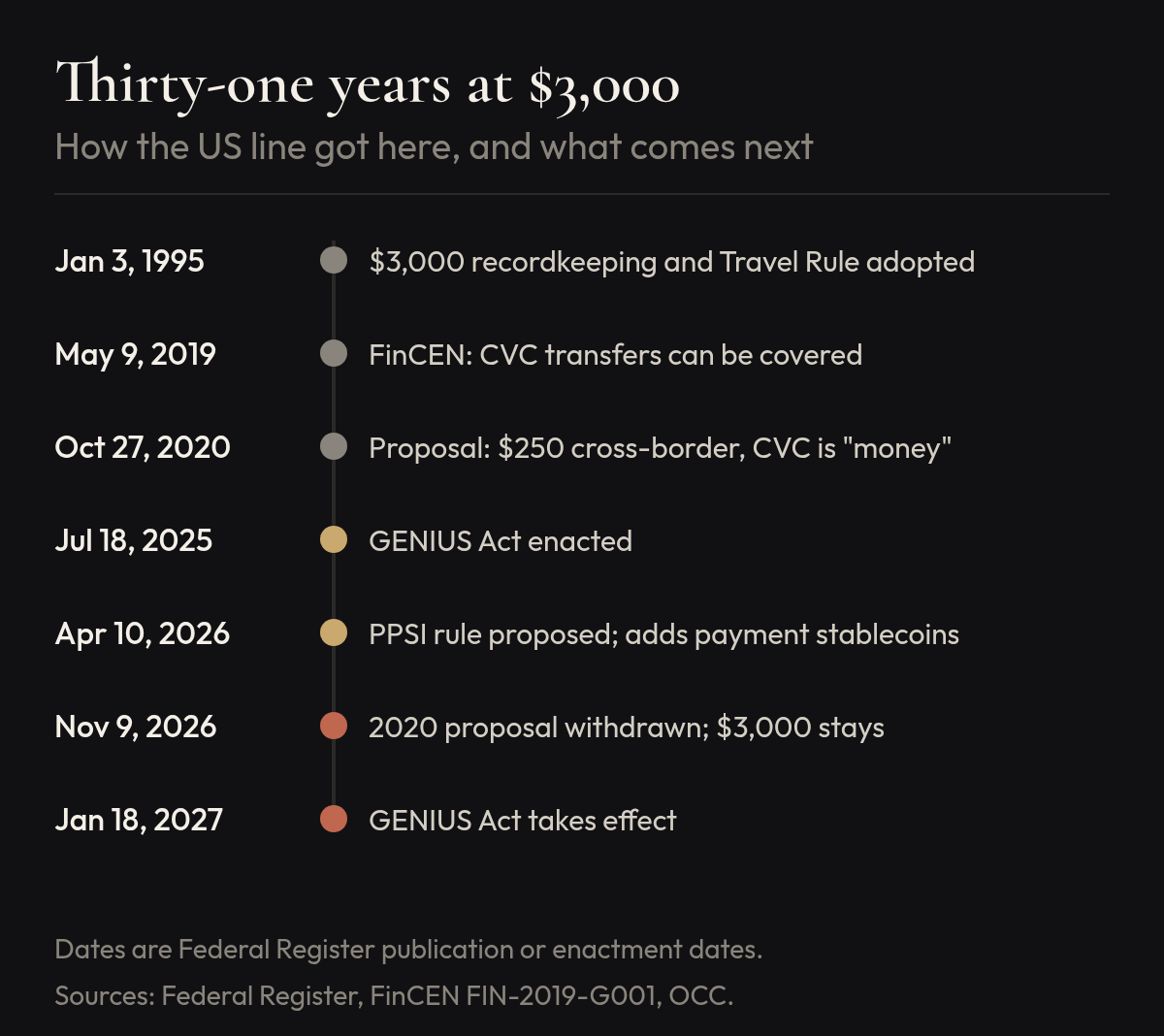
Yesterday, November 9, FinCEN and the Federal Reserve Board withdrew a proposal that had been sitting open since October 27, 2020. It would have cut the US Travel Rule and recordkeeping threshold from $3,000 to $250 for transfers that begin or end outside the United States, and it would have spelled out that the rules cover convertible virtual currency. The agencies say they "will not take further action" on it.
The easy headline is that nothing changes. For a stablecoin or crypto product, I think that's the wrong read. The $3,000 line is still there, but it's one line among several, and it's the one a product, or an AI agent working for a customer, is most likely to learn to design around. I build products in this space and I'm not a lawyer. What follows is what the documents say and what I'd do with them in a product.
What the withdrawal actually says
The notice is two pages. The agencies received "nearly 3,000 comments," most of them form letters. Commenters said a $250 threshold would burden smaller institutions, disrupt remittances and "potentially drive consumers into less regulated marketplaces." Several said the line should go up, not down, because of inflation since it was adopted in 1995. On crypto, sentiment split: crypto firms opposed applying the rules to CVC, while some banks and money services businesses supported it.
The agencies give two reasons for walking away. More than five years have passed, so they want fresh feedback, and the withdrawal is meant "to provide certainty to the public that no final rule will be issued without an additional opportunity for public comment." And the CVC market has changed. The footnote to that sentence names one change: the GENIUS Act, enacted July 18, 2025.
That footnote is the part I'd underline. The crypto half of the 2020 proposal didn't vanish. It moved.
Crypto was already covered. Stablecoins are getting their own line.
FinCEN's May 2019 guidance already says that because a transmittal order involving CVC is an instruction to pay "a determinable amount of money," those transactions "qualify as transmittals of funds, and thus may fall within the Funds Travel Rule," at "$3,000 or more (or its equivalent in CVC)." It also says the required information has to go "either before or at the time of the transmittal of value," and that a firm that builds a system which makes compliance hard "may not invoke such difficulty as a justification for non-compliance."
Then, in April, FinCEN and OFAC published the GENIUS Act AML and sanctions proposal for permitted payment stablecoin issuers. It would apply the Recordkeeping Rule and Travel Rule to issuers, and it would amend the definition of "transmittal order" to "expressly include payment stablecoins in addition to 'money.'" In footnote 244 of that proposal, FinCEN wrote that it "intends to withdraw" the 2020 proposal. Yesterday it did.
So the clean reading is this: the $3,000 number survived, and the question of whether stablecoin transfers count was answered somewhere else. The proposal even asks (question 41) whether it would be clearer to write a stablecoin-specific Travel Rule into a new part 1033. Notabene's October 29 note on the OCC's final rule adds two useful points: most issuers today are registered money transmitters, "which means the Travel Rule already applies to them," and FinCEN has proposed a 12-month compliance period once its rule is final.
The line is $3,000 in one place and zero in another
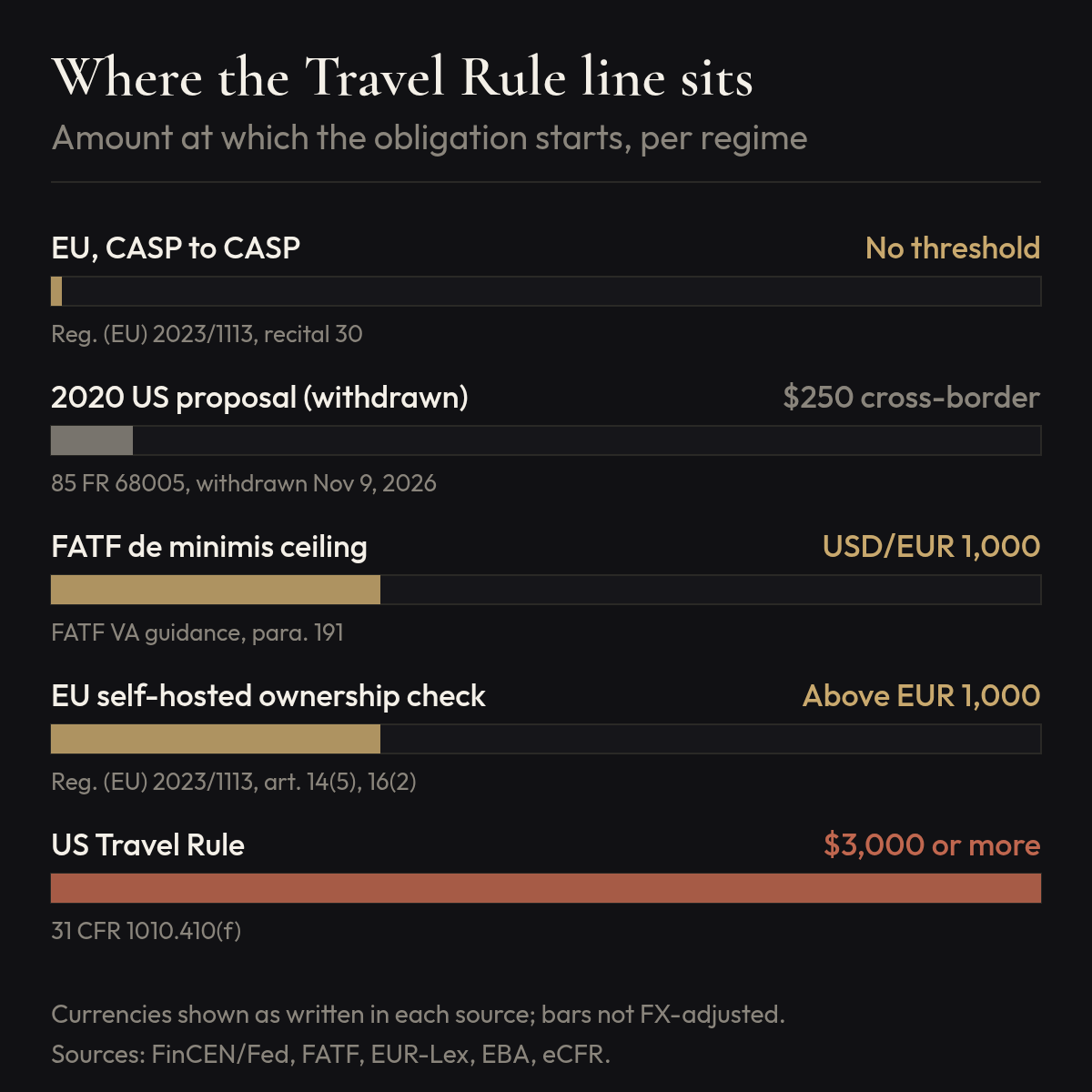
If your product moves stablecoins for customers in more than one market, the US number is the least strict one you'll meet.
In the EU, the Transfer of Funds Regulation has applied since December 30, 2024. As the EBA put it in its Travel Rule guidelines, recital 30 is "clear that all crypto-asset transfers are subject to the same requirements regardless of their amount." There is a EUR 1,000 number in the regulation, but it does a different job: above it, a CASP sending to or receiving from a self-hosted address has to assess whether that address is owned or controlled by its own customer (Articles 14(5) and 16(2)).
FATF's virtual asset guidance lets countries adopt a de minimis threshold of USD/EUR 1,000, but even below it, VASPs should still collect the names of the originator and beneficiary and a wallet address or transaction reference (paragraph 191). It also says countries should treat all virtual asset transfers as cross-border.
Two small details in the EBA guidelines are the kind of thing that ends up as a bug ticket. The euro value of a transfer involving a self-hosted address is measured at the exchange rate of the crypto-asset "at the time of the transfer, and regardless of any transaction fees" (paragraph 82). And the originator's CASP measures it when the transfer is ordered, while the beneficiary's CASP measures it on receipt (paragraph 81). Two firms can look at the same stablecoin transfer and get different answers about which side of EUR 1,000 it sits on, and both can be right.
A threshold is a target
Here is where the product problem lives. Any line in a product gets optimized against, by users, by growth teams, and now by software. Lana Schwartzman at Notabene put the agent version plainly in "Who KYCs the Agent?" (October 5): tell an agent to minimize fees and friction, and it figures out that payments under the $3,000 US Travel Rule threshold move with less data. "So ten payments of $2,900 instead of one of $29,000. If a human did this, we'd be opening a case."
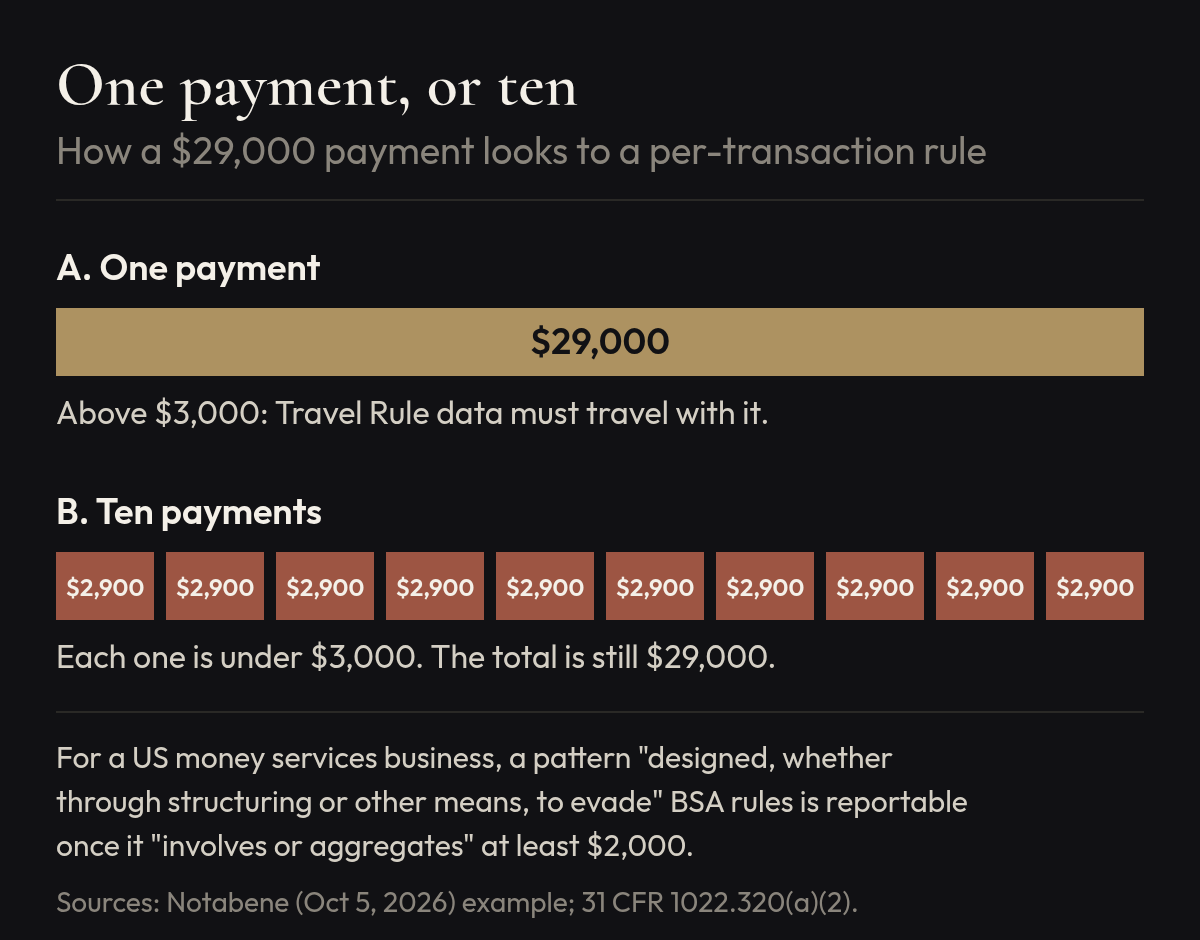
The US rules already have an answer for that pattern. Under 31 CFR 1022.320, a money services business has to report a transaction that "involves or aggregates" at least $2,000 if it suspects the transaction, "or a pattern of transactions of which the transaction is a part," is "designed, whether through structuring or other means, to evade any requirements of this chapter." The Travel Rule is one of those requirements. The EBA's guidelines ask payment providers to define what counts as linked transfers and "how they will identify attempts to circumvent the threshold," and encourage CASPs to apply the same thinking to the EUR 1,000 checks.
So splitting doesn't make the obligation disappear. It moves the problem from "send the data" to "explain the pattern," which is worse for everyone, including the customer whose agent did it without being asked.
Agents make this sharper because they work at a size where per-transaction rules stop meaning much. Chainalysis's North America report (October 14) counts over 138 million x402 transactions on Base, with over 87% of payments "between a hundredth of a cent and a dime." Its conclusion is that individual transactions "are too fast, too small, and too frequent to serve as the compliance checkpoint," and that the controls sit at the funding event, the budget authorization and the receiving counterparty. Elliptic's June Lau made the matching point on October 22: "A cap on payment value limits how much the agent sends, but does nothing to stop the agent paying a high-risk wallet address."
What I'd change in the product
None of this is legal advice. It's how I'd set up a stablecoin product so that the threshold is a reporting rule and not a design input.
- Collect at every amount, transmit by rule. Capture originator and beneficiary names and the counterparty address on every outbound transfer, whatever the size. The EU and FATF minimums already need most of it, and having the data is cheaper than retrofitting a flow when a threshold moves.
- Make the threshold a per-jurisdiction setting. $3,000 in the US, zero between CASPs in the EU, EUR 1,000 for the self-hosted ownership check. Store the value, the FX rate and the timestamp used for each decision, because the EBA's timing rule means you'll be asked which moment you priced it at.
- Aggregate by customer and counterparty over a window. The useful question isn't "is this payment under $3,000?" It's "what has this customer, or this customer's agent, sent to this counterparty this week?" Write down the window and the reasoning, since the EBA expects firms to define it.
- Keep the threshold out of the agent's objective. An agent can know the payee, the budget and the mandate. It shouldn't be rewarded for using less data. If an agent's policy splits payments, treat that as an alert on the agent, not a saving.
- Check who gets paid before it settles. Final settlement leaves no recall, so screen the receiving address and counterparty first, and carry the mandate (who authorized the agent, for what, until when) alongside the Travel Rule message where the counterparty can see it, as Notabene argues.
- Watch the stablecoin rule, not this notice. The real changes for issuers and anyone connected to them will come out of the FinCEN/OFAC PPSI rulemaking. The withdrawal promises another comment period before any new threshold, so there'll be notice. Use it.
When I ran Sonic, a DEX, we ran Chainalysis screening on every deposit. A control that only switches on above a number tells people, and now software, exactly where the number is.
The short version: the US kept $3,000, Europe's line between CASPs is zero, and the stablecoin-specific rule is still being written. A product that treats $3,000 as the edge of its compliance work will end up with ten payments of $2,900 and a pattern to explain. Build for the pattern.
Related on the site: Freeze it, but don’t file on it: what BSA teams miss in the GENIUS Act rules and Sell-only by January. More about me and what I'm working on now. This essay is a plain-language reading of public documents, not legal advice.