Writing Essay
Papertrade made the losers the bank
A new 1000x exchange on Hyperliquid has no order book and no outside liquidity. Every trader plays against one pool that started at zero, and the people who lose end up owning the upside.
I've spent the weekend watching a product that I think breaks most of the rules I'd normally apply to an exchange. It's called Papertrade. It went live on Hyperliquid's HyperEVM on October 10, and its trading screen offers BTC and ETH with a leverage slider that runs from "x1 Safe" to "Wild x1000." That part is loud, but it isn't the interesting part. The interesting part is who's on the other side of your trade.
How it works
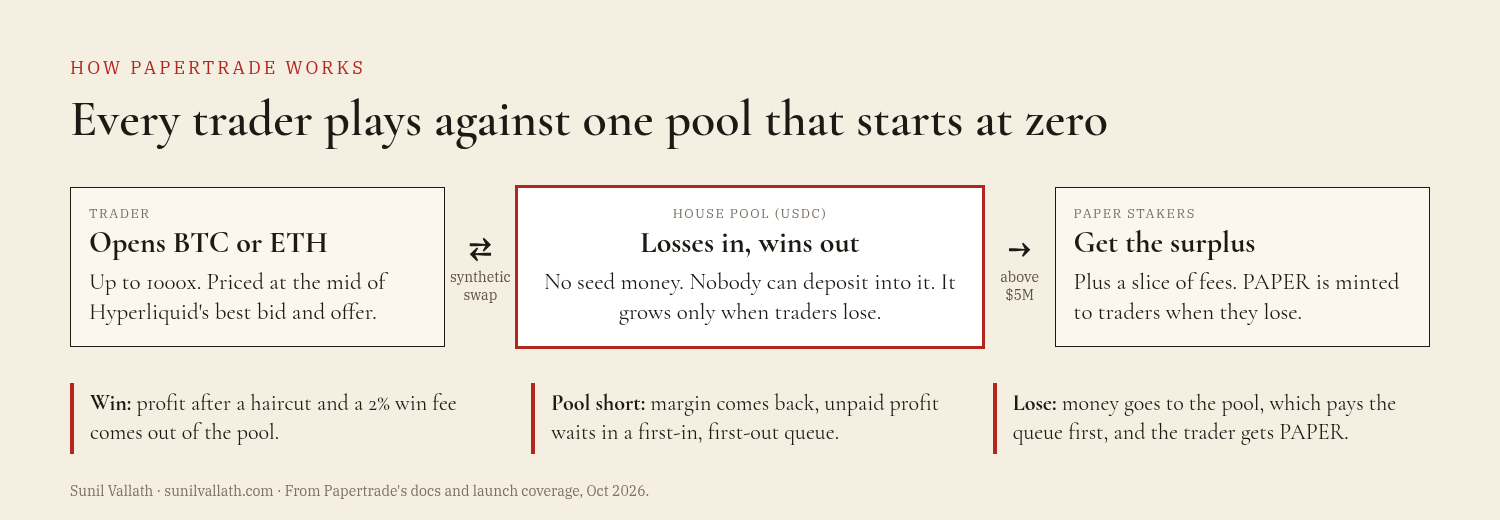
There's no order book on Papertrade and no other trader matched against you. Every position is a synthetic swap against one USDC pool. When you open or close, the contract reads the midpoint of Hyperliquid's best bid and offer and uses that as your price. No perp actually trades on Hyperliquid. Papertrade just borrows its price. There's no funding rate and no normal trading fee, which is why DeFi Prime's pre-launch write-up describes the cost as moving to winning closes. Winners take a haircut on their raw gain, which is bigger on small moves, and then pay a 2% win fee. Losers just lose.
The pool is the house, and here's the first strange thing. It started with nothing. There was no seed money and no founder deposit, and nobody can put money into it directly. It grows only when traders lose or get liquidated, and it shrinks when they win.
So what happens when someone wins and the pool can't pay? You get your margin back right away, and the unpaid profit goes into a first-in, first-out queue as an onchain claim. Later losses refill the pool and pay the front of that queue first. The docs call this a delay, not a haircut. That's true as long as enough people keep losing.
The second strange thing is the token. When you lose, you're minted PAPER. While the pool is under $2 million, it's 100 PAPER for every dollar of eligible loss, and the rate decays after that. There was no pre-mine and no team or VC allocation. You can stake PAPER to earn USDC from the pool, a small share of settlements, and once the pool is above $5 million, the surplus over that cap. The PaperJet docs, written by a separate treasury project that trades on Papertrade, lay out the same numbers.
Why it's wild
Put those two pieces together and the losers become the bank. The pool is built from their losses, and the token that collects the pool's surplus goes to them too. Some people on X have started calling it an onchain casino where the gamblers get paid in house equity. I think that's roughly right.
It also means "LP" doesn't mean what it usually means. On most perp venues, the liquidity provider is someone who chose to deposit capital and take the other side. Here nobody chose that. The pool is just the pile of everyone's losses, and the stakers get paid from it without having put their own capital at risk the way a normal LP would. If you lost money to get your PAPER, you paid for that position, but you didn't sign up to underwrite anyone.
And the cushion is thin. An independent due-diligence report generated on DefiLlama about twelve hours after launch counted 7,434 traders and put open interest at about $3.2 billion against a pool of about $3.41 million. That's roughly 0.1%. It also noted that more than half of all opens were at the full 1000x, and that the contract source wasn't verified and no audit had been found. At 1000x, a 0.1% move against you wipes out your margin. On the pool side, a 0.1% move against the whole net book would be enough to empty it.
Then there's the price. Papertrade reads Hyperliquid's top of book directly, and its own docs name manipulation of that midpoint as the main open risk. It didn't take long. The Block reported that one wallet netted about $1.28 million within hours of launch by pushing ETH prices on Hyperliquid while holding large Papertrade positions. The same wallet later lost $450,000 when 30 shorts were liquidated. Papertrade said on X that its launch open-interest caps had been loose on purpose and that it was tightening them. In the same post it said that one day after launch it had $5 million in the LP and had paid out $25 million to stakers.
What I find most interesting is that people have already found the loop. If losing mints PAPER and PAPER earns the pool's surplus, you can lose on purpose and earn it back in staking. One widely shared post walked through a user who made 1,012 trades, lost about $979,000, and collected about $997,000 in staking rewards. I couldn't check that one myself, but the incentive it describes is right there in the design.
The numbers today
Here's Papertrade's stats panel as I saw it on October 12, 2026.
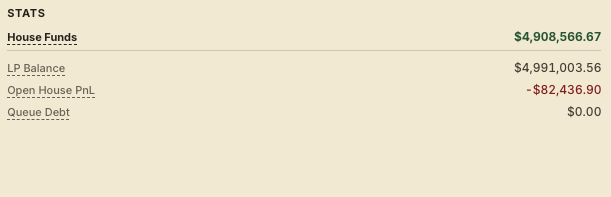
The LP balance is $4,991,003.56, sitting just under the $5 million cap. Open house PnL is −$82,436.90, which means traders are up that much on positions that are still open. House funds of $4,908,566.67 is the LP balance minus that open loss, to within a cent. Queue debt is zero, so every winner who has closed has been paid.
I checked the House page myself at about 1:20 PM ET the same day, and it had already moved. The LP balance was $4,990,784.96, open house PnL had flipped to +$29,089.95, and house funds were $5,019,874.91. Queue debt was still zero, with no positions waiting. The page showed about $656 million of open interest across 1,825 positions, with traders net long about $119 million, and it listed $27.9 million paid to PAPER stakers so far. Almost all PAPER is staked, about 6.12 billion out of 6.2 billion.
That open interest is a lot lower than the roughly $3.2 billion the DefiLlama report counted on the first night, which fits with Papertrade tightening its caps. It also changes the cushion math. A pool of about $5 million against $656 million of open interest is under 1%. Against the $119 million net long, it's around 4%.
That's a healthy-looking panel, and two days in it's more than I expected. But it's a snapshot of a pool worth a few million dollars backing a book of hundreds of millions. It tells you the house is ahead right now. It doesn't tell you what happens on a day the market moves hard in one direction and most of the book is on the right side.
What I'd watch
I wrote last month that Hyperliquid changed what a perp exchange could be. Papertrade is a strange kind of proof of that. It's an exchange built on top of someone else's price, with no market makers, funded entirely by its own users' mistakes.
I'd watch three things. First, whether the queue ever gets long and stays long, because that's when "delay" starts to feel like a haircut. Second, whether the open-interest caps actually stop the price games or just make them smaller. Third, whether there are enough natural losers once the farming gets crowded. A design that pays people to lose works as long as most of the losing is real.
I don't think it's a scam, and I don't think it's safe. It's one of the most honest designs I've seen in a while about where the money comes from. It just happens that the answer is the people trading.
Related on the site: how Hyperliquid changed perpetuals. More in the writing hub.