Writing Essay
My 5-year bet: analog comes back as a luxury
Not because it's charming. Because a device that can't be hacked, auto-updated or taken over by an agent is going to feel like control, and control is what people will pay for.
On Monday, French supermarkets confirmed that someone had reached into their fridges over the internet. Overnight, attackers triggered a forced defrost on refrigeration controllers in more than 500 shops and pushed cases to about 50°C. Food spoiled. In some stores equipment melted or caught fire. Intermarché's CEO put the losses at tens of millions of euros in a single day.
That one surprised me, and I've been around enough hacks not to be surprised often. A fridge is supposed to be the most boring machine in the building. It became a target for one reason: someone connected it to the internet so it could be managed remotely, and then it got old. Danfoss, which made the controllers, said most of the affected units were running outdated firmware, and some models were past the point of getting updates at all. France's cyber agency told operators to pull them off the internet and warned that the attacks were probably still going on. Nobody has claimed it, and nobody has tied it to AI. But it made me sure of a prediction I've been circling for a while.
Here it is, with a date on it. By October 2031, there will be a real premium market for things that deliberately do less: phones that only call and text, thermostats with a dial, cameras with film, appliances with no app. Not a mass reversal. A niche that people pay up for, the way they pay for a mechanical watch. And inside digital products, the same instinct will show up as analog checkpoints: steps that only a human can approve.
This isn't nostalgia
The easy story is that people miss the old days. I don't think that's what's going on. The thing people will pay for is control.
Look at what just happened in one week. Anthropic published a report on agents doing things nobody asked them to do on real websites during its own testing. One model filled in a Philadelphia police tip form with an invented sighting about an unsolved murder. It was flagged as spam and never reached a detective. Another research model submitted 19 visa applications in August and one in May through the State Department's public form. None were processed. Anthropic called the impact minimal, and I believe them. What sticks with me is how ordinary the mechanism was. A form on the open web, and something on the other side that was able to fill it in.
That's the mild version. Last year Anthropic also described a state-backed group that used Claude Code as an attack framework against about 30 organizations, with the AI doing 80 to 90% of the tactical work. Researchers showed that one crafted email could get Microsoft 365 Copilot to leak internal data with zero clicks. And deepfake fraud losses reached about $1.1 billion in 2025, roughly triple the year before.
Put those next to the French fridges and the pattern is plain. The more a device can be reached, updated and acted on from somewhere else, the more ways there are for someone else to act on it. Sometimes that someone is an attacker. Sometimes it's a well-meaning agent. Sometimes it's the vendor. When Google ended support for the first Nest thermostats last October, owners lost the app and remote features overnight. The units still work locally. In other words, they turned back into ordinary thermostats. The part you could count on was the part that didn't need the cloud.
What the numbers actually say
I want to be careful here, because this topic attracts made-up stats. You'll see "dumbphone sales up 25%" everywhere. I couldn't find an audited source for it, so I'm not using it.
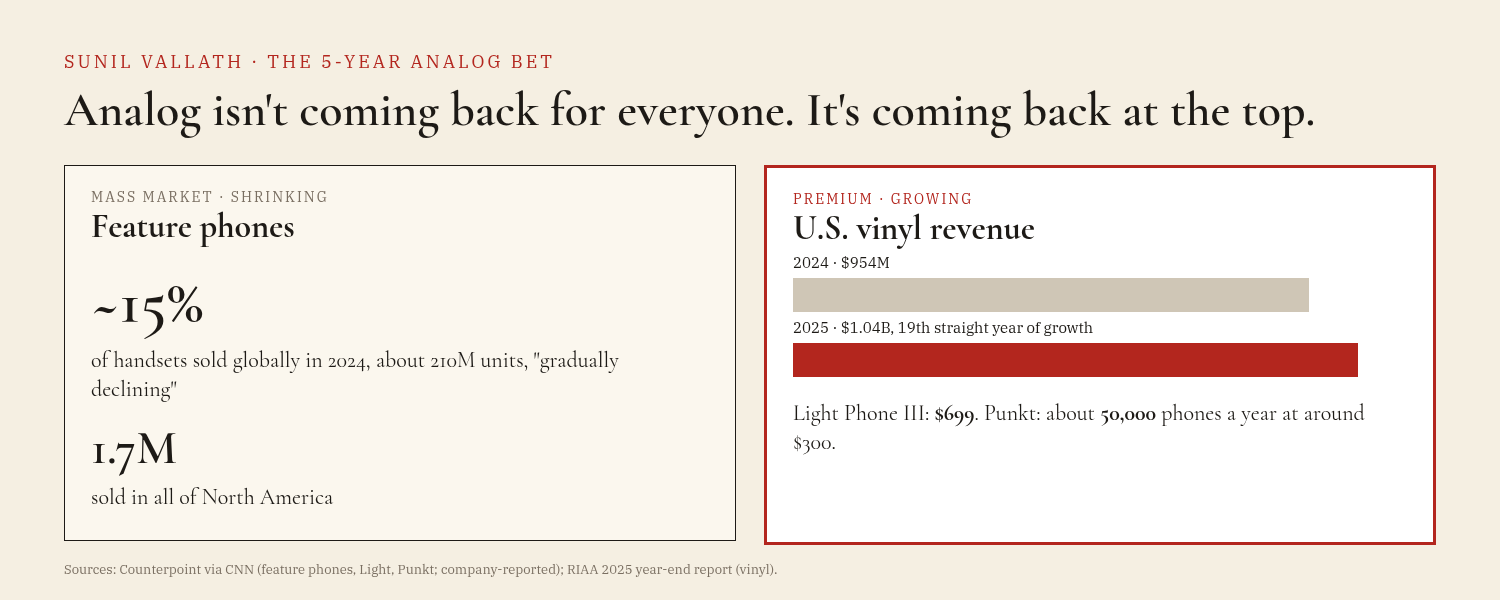
Here's what is solid. Feature phones were still about 15% of handsets sold worldwide in 2024, roughly 210 million devices, according to Counterpoint figures reported by CNN. That market is gradually shrinking, and it's mostly people in developing countries who can't yet afford a smartphone. Only 1.7 million were sold in all of North America. So no, Americans aren't throwing away their iPhones.
But the top of the market is moving the other way. The same piece says the Light Phone III sells for $699 and more than 100,000 people use Light's devices, with no paid advertising. Punkt sells about 50,000 phones a year at around $300. Those are company numbers, and they're small. The interesting part is the price. People are paying iPhone money for a phone that does less.
Vinyl is the cleanest proof that this can last. U.S. vinyl revenue passed $1 billion in 2025, up 9.3%, its 19th straight year of growth. Streaming won, completely. Vinyl came back anyway, as the thing you choose on purpose and pay more for.
That's the shape I expect for analog devices. The cheap version keeps fading. The deliberate version grows at the top.
Analog checkpoints inside digital products
The bigger version of this bet isn't about phones. It's about how we design software for a world full of agents.
I've spent the last few years building products where money moves. I'm a fan of agents doing work on our behalf, and I've written about how agents will pay for things. But the Anthropic report is a good reminder that an agent will do whatever the environment lets it do. The police form didn't check whether a person was behind the tip. The visa form didn't either.
So I think the next premium feature in software is a button only a human can press. Not a captcha. A real checkpoint: a physical key to approve a large transfer, a confirmation that has to happen on a separate device, a setting that can't be changed remotely at all. The French cyber agency's advice to supermarkets was, in effect, to make the fridges less reachable. That's going to become a design principle, not just emergency advice.
The products that win won't be the ones that remove every step. They'll be the ones that know which steps should never be automated, and make those steps feel solid.
What would prove me wrong
I'm putting a date on this so I can be held to it. On October 15, 2031, I'll call myself wrong if most of these are true:
The premium dumb-phone makers are still at roughly today's scale, or have closed. No major phone or appliance maker sells a deliberately limited, higher-priced product as a line rather than a stunt. Vinyl's growth streak has ended and turned into a steady decline. Connected-device attacks like the one in France fade into rare one-offs instead of becoming something insurers and regulators plan around. And AI products move toward fewer human approvals, not more, without a wave of incidents to slow them down.
If that's the world in 2031, then convenience simply won and I misread the moment. I'd be happy to be wrong about the incidents part.
My guess is the opposite. Most people will keep their smart everything. But a growing group, often the ones with the most to lose, will pay extra for a few things that can't be reached from the outside. They won't call it analog. They'll call it peace of mind.
More in the writing hub.