Writing Essay
2% of households pay for AI. That's a product problem, not a model problem.
Card data says roughly one in fifty U.S. households pays for an AI subscription. A product view of why usage is not willingness to pay, what people actually buy, and what builders should do about it.
Only about 2% of U.S. households pay for an AI subscription. That number came up last week on an episode of TechCrunch's Equity podcast, and it stayed with me after the episode ended. Hundreds of millions of people use AI every week. Very few of them have decided it's worth paying for.
I build products in fintech and digital assets, where the gap between someone trying a product and someone trusting it with money is the whole job. So I went looking for where the 2% comes from and what it actually measures. The episode was the prompt. What follows is my own read.
Where the 2% comes from
The hosts were working from Russell Brandom's TechCrunch piece, "The ugly economics of consumer AI," which cites Andreessen Horowitz's State of Markets II report. a16z took its chart from PNC. The primary source is PNC Economics Research's Consumer Health Check from June 15, 2026: the share of PNC households paying for a Gen AI subscription reached 2.2% in May 2026, based on the bank's internal card data. Paying households spent about $31 a month on average, up from about $22 two years earlier. More than 4% of higher-income households paid, compared with about 2% of middle-income households and less than 1% of lower-income households.
Two details matter. It's households, not individuals, and it's one bank's customers. It also only sees money that leaves the household's own cards, so a ChatGPT seat paid for by an employer doesn't count.
Bank of America's payments data points the same way. In March 2026 the Bank of America Institute reported that only around 3% of its households pay for AI services, even though the number of paying households was up 38% versus the 2024 average.
Why the numbers don't agree
If you follow AI news every day, 2% sounds wrong. It depends on who you count.
OpenAI said in February that ChatGPT had more than 900 million weekly active users and more than 50 million consumer subscribers. That's roughly one paying subscriber for every eighteen weekly users. Menlo Ventures' 2026 State of Consumer AI survey, fielded with Morning Consult in July, found that 55% of U.S. AI users say they pay for at least one AI product.
The numbers measure different things. PNC asks whether a household card was charged for an AI subscription. OpenAI counts subscribers against everyone who opened the app that week. Menlo asks people who already use AI whether they pay, and its own report notes that 34% of payers have a family member or friend covering it and roughly 20% have an employer or school picking up the tab.
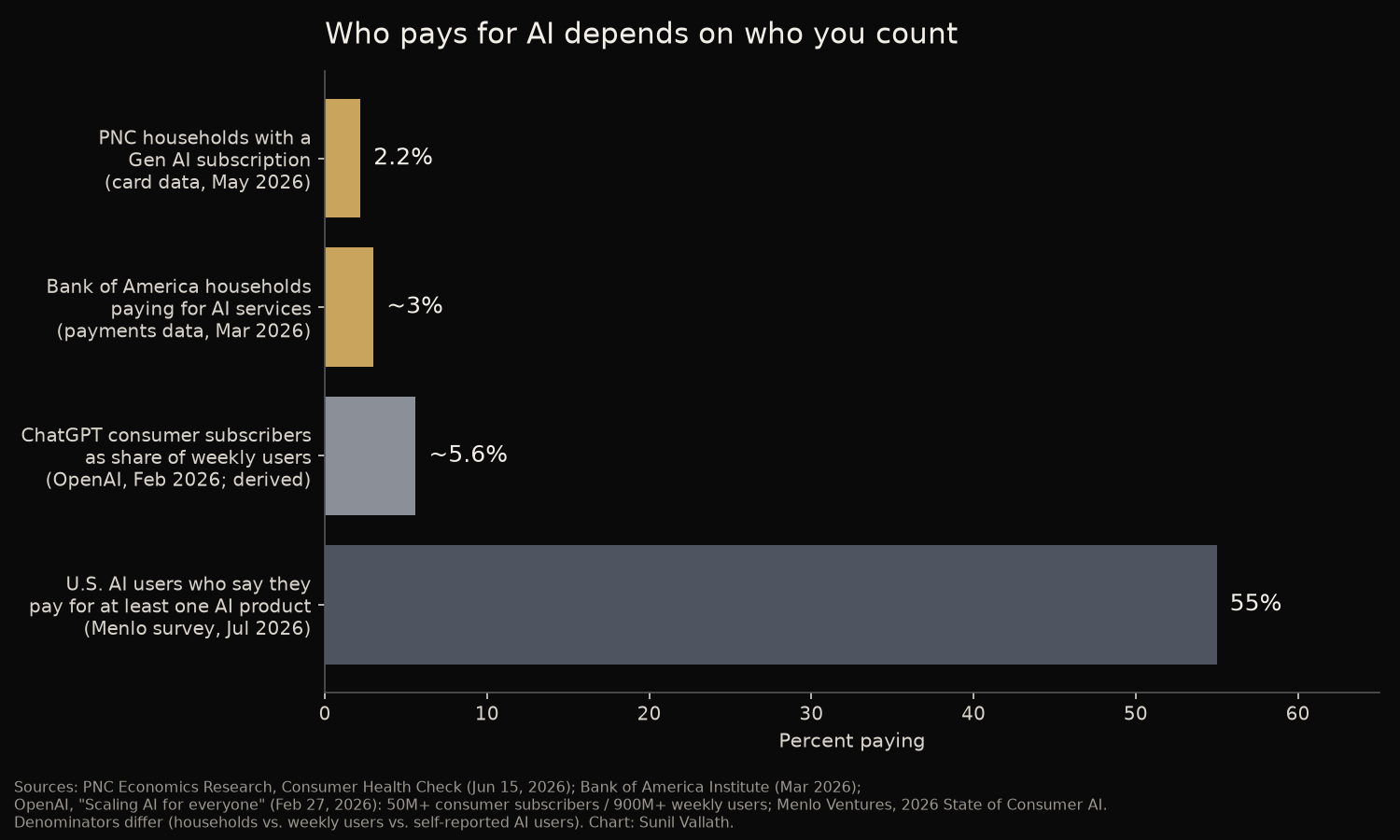
I'd use all of these, but I'd anchor on the one where money actually moved. Surveys tell you what people believe about themselves. Transactions tell you what they did. At Lume, the number I watched most closely wasn't sign-ups. It was how fast someone got to their first funded trade, which we brought down from weeks to under 60 seconds. A download is curiosity. Money moving is commitment.
Using something is not the same as paying for it
The usage is real. A Federal Reserve note from April found that about 41% of U.S. workers used generative AI for their jobs as of November 2025, and about half the population used it outside work. Menlo puts adoption at 64% of U.S. adults.
So people use AI. The problem is that free is good enough for most of what they use it for. Drafting an email, summarizing a page, answering a question. The free tier handles those well, and the paid tier mostly offers more of the same: more messages, better models, fewer limits. That's a strong pitch to someone who hits the limits every day. For everyone else it's an upgrade to something they already get for nothing.
Menlo's data shows who crosses over. Payers are nearly twice as likely as non-payers to use AI daily, 50% versus 26%. The 14% of payers who spend $100 or more a month account for 60% of consumer AI spending. For now the money comes from a smaller group of people for whom losing access would actually hurt.
What people actually pay for
In my experience people don't pay for technology. They pay for an outcome they can't easily get elsewhere, from someone they trust, inside a habit that's already part of their week. AI delivers the first part for some users. It's still working on the other two.
Trust is the one I'd watch. In Menlo's survey, AI users now rank accuracy (45%), trustworthiness (40%) and security and privacy (36%) ahead of ease of use (32%). Among people who don't use AI, 70% say they distrust the information it gives, up from 58% a year earlier. Fintech taught me this early. Nobody funds an account because the interface is pretty. They fund it because they believe the money will be there tomorrow, and that someone will answer if it isn't.
The other thing people pay for is the bundle they already have. In January 2025 Microsoft added Copilot to Microsoft 365 Personal and Family and raised the U.S. price by $3 a month, the first consumer price increase since 2013, according to CNBC. Google put Gemini inside search, Android and Workspace, and Menlo found Gemini's reach among AI users went from 36% to 58% in a year. Whether those customers think of themselves as paying for AI is an open question. I expect a lot of consumer AI revenue to look like this: a few dollars added to a bill people already pay, not a new line item they went looking for.
The capex question
This is where the 2% stops being a consumer story and becomes a business model story. Combined 2026 capital spending guidance from Microsoft, Alphabet, Amazon and Meta adds up to roughly $720 billion to $745 billion. Not all of that is AI, and very little of it is aimed only at consumers, but it sets the scale. Menlo estimates global consumer AI spending at about $40 billion this year, more than triple 2025. That's fast growth. It's also a small slice of what's being built.
The labs seem to have done the math. Brandom describes an industry-wide shift toward enterprise contracts, and the Equity hosts made the same point: companies preparing to go public are leaning on enterprise because that's where the budgets are. OpenAI reported more than 9 million paying business users in the same post as its consumer numbers. The consumer app is becoming the top of a funnel that ends in a company contract. That's a reasonable business. It's just a different story from "a billion people will pay for AI."
What I'd do if I were building consumer AI right now
I'd pick one job where a mistake is expensive and do it better than a general assistant can. Menlo found that some of the lowest-penetration activities, like paying bills and navigating healthcare, are exactly the ones where getting it wrong costs real money. I'd still go there, but I'd earn trust in small, checkable steps before asking for more.
Pricing should follow the outcome, not the access. "More messages" is a weak reason to pay. "Your subscription is cancelled and here's the confirmation" is a much stronger one.
I'd plan for distribution through something people already pay for. A standalone $20 subscription competes with free and with every bundle from a company that already owns the bill.
And I'd measure the funded moment. Weekly actives are flattering. What matters is how many people paid, kept paying, and would be upset to lose it.
Where this leaves me
I don't read 2% as proof that consumer AI is a bubble. Spending is growing, and the people who pay are paying more. I read it as a reminder that usage and willingness to pay are two different curves, and the second one moves on trust and habit, not on model releases. New names won't move that curve either. Products people would miss will.
Career context: Who is Sunil Vallath? Past proof on the site: Lume case study. Related craft: AI incidents, guardrails, and trust and building products people use. More on sunilvallath.com and the writing hub.