Writing Essay
Agents can pay as you. They still can't fund you.
a16z's Wallet Wars piece maps the fight over who lets an agent pay as you. It skips the step where I've watched payments actually die: getting money into the account.
Last week a16z published Wallet Wars, by Terry Angelos, chief strategy officer at VGS. It's one of the clearest things I've read on agent payments. His starting point is that an agent needs something intelligence can't give it: permission to pay. Then he splits the fight in two. One battle is over who helps your agent pay. The other, which he thinks matters more, is over who lets it transact as you.
I agree with most of it. The piece explains why a virtual card can complete a purchase and still break the relationship behind it. When Stripe's Link pays a merchant with its own single-use card, there are really two transactions, one between you and Link and one between Link and the merchant. Walmart offers you Walmart+ and the cards don't match. You book a United flight with your MileagePlus card through Link and the miles may never show up. He calls Stripe the AOL of agentic commerce, and the line I keep coming back to is that an agent needs a payment policy, not just a payment credential.
But the whole piece starts after the hardest step. Every wallet in it already holds a funded card: Link with 300 million users, Shop Pay with 250 million, PayPal with more than 400 million. The question is only who gets to use that card, and how faithfully. For a lot of the world, that isn't where payments fail. They fail earlier, when money can't get into the account at all.
The card is the assumption
Tokenization, as Angelos describes it, separates the identity of the paying account from the authority to start a payment. That's decades of real progress, and agents push it one step further. But a token points at something. It's a safe way to say "charge this card." If there's no card, or the card can't be used for what you're trying to buy, the token has nothing to point at.
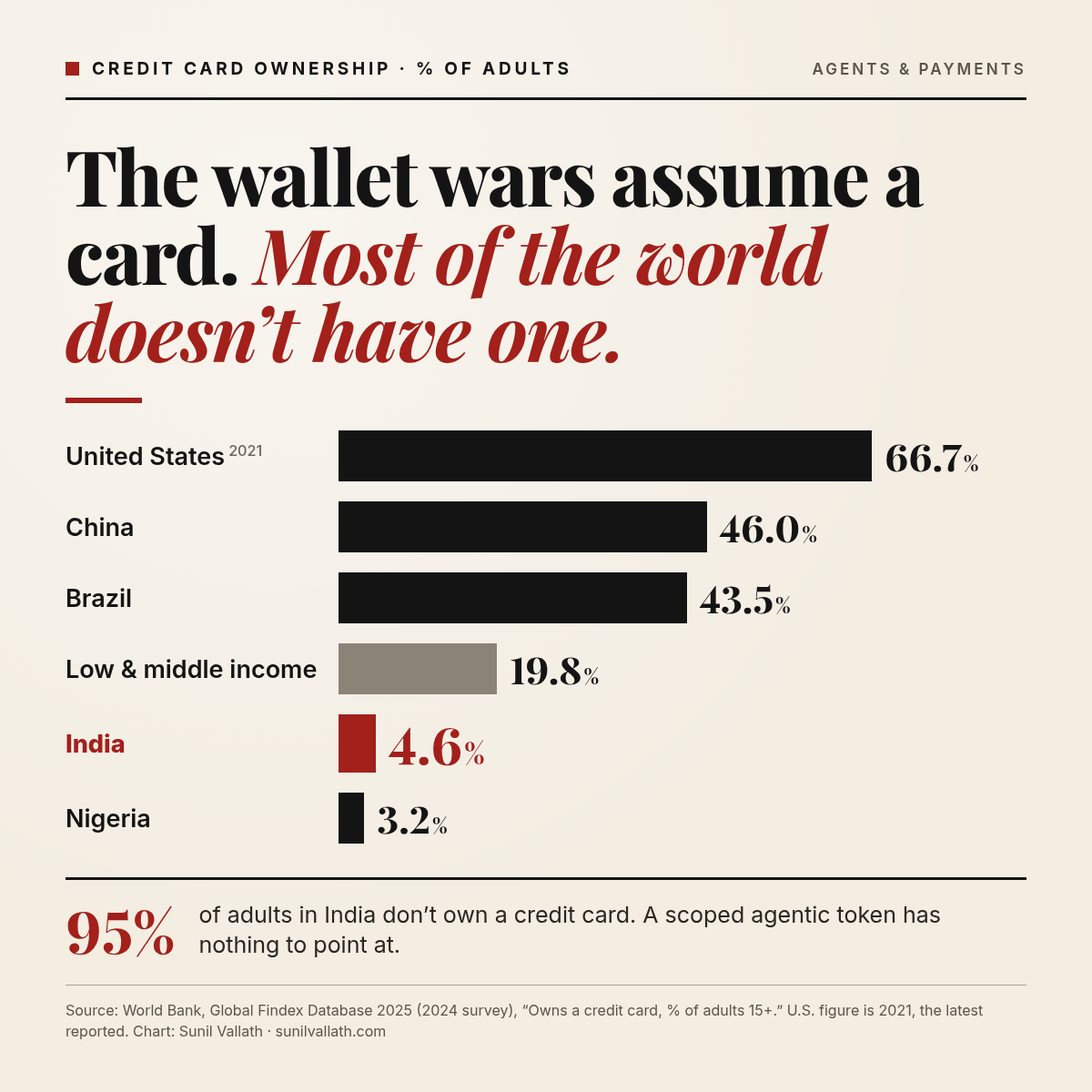
In the U.S. that's a fair assumption. About two in three adults there own a credit card, according to the World Bank's Global Findex (66.7% in 2021, the latest U.S. figure). In India, the same survey puts it at 4.6% of adults in 2024. Across low- and middle-income economies it's 19.8%. Most people there pay with bank transfers, UPI and cash instead. When they want something card rails don't serve well, like dollar stablecoins or a tokenized U.S. stock, the first job is turning local money into the thing the product needs. None of the wallet wars cover that job.
What it looked like from inside a product
I learned this the expensive way. Our product was a decentralized app for buying tokenized U.S. stocks with USDC. The trading part worked. Once someone had USDC in their wallet, they could find a stock, see a price and buy it in seconds.
Getting the USDC there was the problem. Most of our users were in India, and India keeps squeezing the companies that turn rupees into crypto. This June, the Enforcement Directorate searched premises linked to five crypto payment companies in Bengaluru, including on-ramps, over alleged cross-border violations. Those raids took down the on-ramps our users relied on. I wrote about it at the time. The app kept working, and users in India still couldn't get money in. We added backup on-ramps. The government shut those paths down faster than we could add new ones.
Nothing in our authorization flow was broken during any of this. Users had wallets, keys and permission to trade. What they didn't have was money in the right form, in the right place. If an agent had been trading for them, it would have had perfect permission and an empty balance.
That's what I mean when I say tokens solve authorization, not funding. I made a version of this argument in July, in The agent can pay. It just can't fund the payment., about machine payments where a seller names one token on one chain. The wallet wars make the same blind spot easier to see on the consumer side.
We already built the scoped credential
The second thing I'd add is that part of the future Angelos describes already exists, just not on card rails.
His best case is a trusted wallet that creates a scoped agentic token before each transaction. The token only works with one merchant, carries limits like "don't spend more than $100," and maps back to your real card so the rewards and protections carry through. Visa (Intelligent Commerce), Mastercard (Agent Pay) and Amex (ACE) are each building a version. Amex's write-up talks about spending limits, merchant restrictions and short-lived credentials.
When we picked a wallet for our product, we chose an embedded Privy wallet on purpose. With MetaMask or Phantom, the user approves every action in a popup. That's the right default for a person clicking buttons. It doesn't work for a limit order that fires at 3 a.m., or for automated and agentic trading where nobody is watching the screen. An embedded wallet lets the app act inside rules the user agreed to. Privy calls these signers. The user lets the app's server sign for their wallet, even while they're offline, and the private key stays in a secure enclave the server never sees. Signers can be tied to policies with transfer limits, allowlists of recipients and contracts, allowed networks and time-bound permissions. Anything a policy doesn't allow is denied by default.
Put that next to the agentic token. A spend cap, a short list of counterparties, an expiry, and a key the agent never holds. It's the same shape. Stablecoins plus embedded wallets with spend limits are an open version of the scoped credential, and they run today without a card network in the middle. They also work for the person who never had a card.
I'm not saying crypto wins the wallet wars. Stablecoin wallets have their own funding problem, which is the point of this essay. If anything, they make the problem harder to ignore. A card hides funding behind a credit line. A wallet shows you the balance, and you can see it's zero.
Four places an agent payment breaks
Put his list next to mine and I see four places an agent payment can fail: funding, authorization, routing and liability. The wallet wars are mostly about authorization and routing. Liability is starting to get attention. Amex has said it will offer Agent Purchase Protection for eligible purchases by registered agents. Funding gets almost no attention, even though it's the step where I've watched the most people get stuck.
What I'd build
If I were building an agent that spends money today, these are the four things I'd want in place before launch.
A written payment policy. Angelos is right that "buy it" isn't a complete instruction. Write down which method the agent uses for which kind of purchase, whose economics it favors when the user's, the merchant's and yours conflict, and when it has to stop and ask. If you can't explain the policy to a user in two sentences, the agent won't follow it well either.
Scoped limits enforced outside the model. The cap belongs in the credential or the wallet policy, not in the prompt. A token that only works at one merchant, or a signer that can only send a set amount to an allowlisted contract, still holds when the agent misreads the request.
More than one funding path, and a way to watch them. Assume your cheapest on-ramp will disappear. Support at least two independent ways to get money in, check that they don't depend on the same bank partner, and track whether transfers actually finish, not just whether they start. When a path goes down, the agent should tell the user plainly instead of hunting for a looser way to pay.
A refund path before the first wrong booking. Angelos asks who makes it right when the agent books the wrong hotel dates. Decide that before launch. Know which mistakes the card issuer or wallet will cover, which ones you'll cover, and how a user reaches a person. With stablecoins this matters even more, because a transfer can't be charged back. The refund has to be something you built, because the network won't give you one.
I think Angelos is right that open standards will win the fight over who lets an agent pay as you, the way the open web beat AOL. But an agent that can transact as me is only useful if there's money for it to spend. For most of the people I've built for, getting that money in is still the hard part.
More in the writing hub.